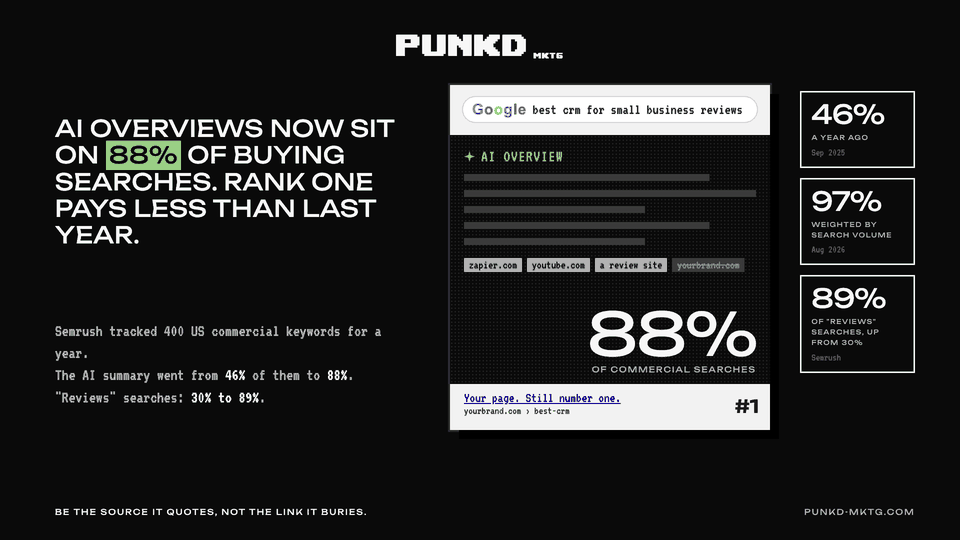
AI Overviews now cover 88% of buying searches. Rank one pays less than last year.
TL;DRAt a glance
- Semrush tracked 400 US commercial keywords from September 2025 to August 2026. AI Overviews appeared on 45.75% at the start and 88% at the end.
- Weighted by search volume, coverage hit 97.08%.
- "Reviews" searches went from 30% to 89%. "Best X for Y" searches went to 96%.
- Ecommerce keywords rose from 32.62% to 85.11%; ecommerce pricing queries from under 5% to 71%.
- Semrush's own line: ranking number one "likely won't lead to as much traffic as it did this time last year."
- Below: the numbers, who gets quoted instead of you, the study's limits, and four moves.
Google now answers the searches people run right before they buy. Not some of them. Almost all of the ones Semrush could track. Here is what the study found, what it did not measure, and what to do about it.
WHAT SEMRUSH MEASURED
On 21 October Semrush published a 12-month study by Luke Harsel, with Nikola Manojlović contributing. The panel: 400 US commercial keywords across banking, software and ecommerce. Each keyword carried one of five buying modifiers: alternatives, brand vs brand, best X for Y, pricing or cost, and reviews. Semrush checked, on US desktop, whether Google showed an AI Overview, the AI-written summary that sits above the normal results.
THE HEADLINE NUMBERS
Across the whole panel, AI Overviews appeared on 45.75% of keywords in September 2025 and 88% in August 2026. Weight the keywords by how often people search them and coverage reaches 97.08%.
- Every modifier moved the same way:
- Reviews: 30.14% to 89.04%.
- Best X for Y: 42.72% to 96.12%.
- Alternatives: 48.44% to 82.81%.
- Pricing or cost: 43.59% to 82.05%.
- Brand vs brand: 63.41% to 86.59%.
By industry, ecommerce rose from 32.62% to 85.11%, software from 68% to 91%, and banking finished near 89%. Twelve of the fifteen industry-modifier combinations sit at 80% or more. Three sit at 100%: best X for Y in banking, and both alternatives and best X for Y in software. The sharpest single climb: ecommerce pricing queries, from 4.76% to 71.43%.
Semrush's conclusion, in its own words: "Expect an AI Overview above organic results on nearly any commercial keyword you target." And the sentence every SEO report should now start with: "ranking number one likely won't lead to as much traffic as it did this time last year."
WHO GETS QUOTED INSTEAD OF YOU
The study's worked example is the search "mailchimp vs klaviyo". The AI Overview quoted Klaviyo's own guide for the Klaviyo recommendation, a Zapier article for the Mailchimp recommendation, a YouTube video and another third-party site. The brand's page is one voice among several, and a neutral third party often gets the decisive sentence. In an earlier Semrush report from June, across 126 million prompts, an AI Overview carried 9.2 citations on average. Nine seats, and your page is competing for one of them.
WHAT THE STUDY DOES NOT TELL YOU
PPC Land's read of the methodology is fair, so we repeat it. The panel is US desktop only. It measures whether a summary appears, not whether anyone clicks it or buys. Semrush did not publish keyword counts per cell; at under 27 keywords per industry-modifier cell, one keyword can move a number by three to five points. Volume weighting uses Semrush's modelled estimates. And Semrush, now part of Adobe, sells the tracking tools its recommendations call for.
None of that changes the direction. For context, a separate study of 100 sites' Google Analytics 4 data found ChatGPT sends 0.62% of the visits Google organic does. AI assistants send a trickle. AI Overviews take the click before it happens.
WHAT THIS MEANS FOR YOUR PAGES
The comparison page, the pricing page and the "best X for Y" guide were the pages that paid for SEO. They are now the pages Google summarises. Two things follow. First, the first two lines of those pages have to contain the answer (who it is for, what it costs, when to choose the rival), because that is the part a summary lifts. Second, being on your own page is not enough. You need to be in the Zapier-style guide, the YouTube review and the review site that the summary quotes.
THE PUNKD TAKE
Rank one used to be the prize. Now it is a footnote under Google's paragraph. We would rather be the source Google quotes than the link it buries, and the only way to be quoted is to publish the honest comparison before someone else publishes it about you. Most brands will keep buying rank reports. We would buy the sentence.
STEAL THIS
- List your 20 money keywords (your category plus vs, best, pricing, reviews, alternatives). Record which show an AI Overview and what it says about you. Repeat monthly.
- Rewrite the top of every comparison and pricing page so the first two lines answer the question outright, including when a rival is the better pick.
- Pitch the third parties the summaries quote: comparison guides, YouTube reviewers, review sites. Get the facts about your product correct there first.
- Change the SEO scorecard: revenue, assisted conversions and branded search, not average position.
THE SHORT VERSION
- AI Overviews now appear on 88% of tracked commercial searches, 97% by volume.
- Review and "best for" searches are almost fully covered.
- The summary quotes third parties as often as brands.
- Write the answer first, get quoted elsewhere, and stop paying for rank alone.
When Google summarises your category, whose words does it use?
We fix the pages machines read, not just the ones people scroll.
Book Free Consultation