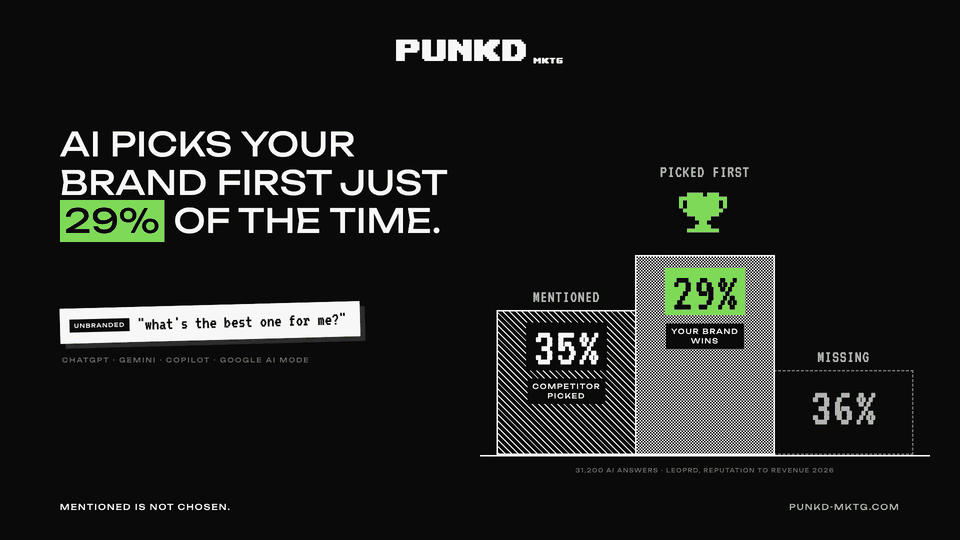
AI knows your brand. It still picks your competitor.
TL;DRAt a glance
- In 31,200 AI answers, brands were the first recommendation only 29% of the time.
- They were missing in 36% and mentioned but passed over in 35%.
- Brands that lost the answer had slightly more citations than brands that won it.
- 86% of citations came from sites the brands do not own.
- The same question gave the same outcome only 40% of the time, so measure patterns, not single answers.
- Win with one specific, provable claim repeated where AI reads, not with vague praise.
- Showing up in an AI answer is not the win. Being the one the AI recommends is.
- A new study shows most brands lose that second step, even when the AI clearly knows who they are. Here is what the data says, why more citations did not help, and how to audit your own share of AI choice.
WHAT THE STUDY MEASURED
LEOPRD, an Australian AI advisory firm, released its Reputation to Revenue 2026 report on 29 September. Its monitoring covered 27 brands across 7 categories and 8 AI platforms, including ChatGPT, Gemini, Copilot and Google AI Mode, in Australia and Great Britain. The analysis used 31,200 AI responses drawn from a programme of more than 214,000.
The key test was unbranded questions: prompts like "what is the best budgeting app?", where the person does not name a brand. That is where new customers are won. The results:
- Missing from the answer: 36%
- Mentioned, but a competitor was chosen: 35%
- The primary recommendation: 29%
One commercial note: LEOPRD sells AI visibility advice, so it has a stake in this problem. Use the numbers as a strong signal and test your own brand before you act.
VISIBLE IS NOT CHOSEN
The gap between being seen and being picked is huge in some categories. Fintech brands appeared in 92% of relevant answers but were first choice in only 32% of the answers they appeared in. Travel and transport brands appeared in 90% and were first choice 28% of the time.
Then there are the brands AI loves. Canva appeared in 86% of relevant answers and was first choice in 99.7% of them. Octopus Energy appeared in 97% and was first choice in 92.9%. Our read: both are brands the web describes the same clear way, over and over. The AI repeats what the web already agrees on.
WHY MORE CITATIONS DID NOT HELP
A citation is a source the AI links to or relies on in its answer. You would expect more citations to mean a better result. They did not. Answers where the brand was mentioned but not chosen averaged 9.2 citations. Answers where it was the primary recommendation averaged 8.4.
What mattered was what those sources said. 86% of citations came from outside the brands' own properties: media, comparison sites, reviews, communities and research. In one example from the report's author, only 10% of SafetyCulture's citations came from its own content, and 55% came from commercial content, including comparison pages and competitor websites. Your competitors are writing part of your AI reputation.
Generic claims like "trusted" or "good value" give the AI nothing to work with. Specific claims do: who you are for, what you beat, and the proof.
THE ANSWER CHANGES EVERY TIME
Only 40% of repeated test groups returned the same recommendation outcome every time. Ask the same question twice and you might win once and lose once. As LEOPRD's founder Celia Harding put it: "One answer is an observation, your AI reputation is a pattern." So never judge your AI presence from one screenshot.
HOW TO AUDIT YOUR SHARE OF AI CHOICE
A worked example with made-up numbers. Write 20 unbranded questions your buyers really ask. Run each on ChatGPT, Gemini and Google AI Mode, three times each. That is 20 x 3 x 3 = 180 answers.
- Log each one as missing, mentioned or picked. Say you get: picked 27, mentioned 63, missing 90.
- Share of choice: 27 ÷ 180 = 15%.
- Share of mention: (27 + 63) ÷ 180 = 50%.
- Conversion from mention to choice: 27 ÷ 90 = 30%.
Now read the answers where you lost. Which competitor won, and what reason did the AI give? That reason is the sentence you need to own.
WRITE THE SENTENCE AI CAN REPEAT
Pick one job, for one buyer, with proof. "The payroll app for restaurants with fewer than 50 staff, set up in a day." Then make that sentence true everywhere AI reads: your site, comparison pages, review profiles, press coverage, partner listings. Consistency is the point. If ten sources describe you ten different ways, the AI picks the competitor with one clear story.
THE PUNKD TAKE
Everyone is celebrating "we showed up in ChatGPT". A mention is a participation trophy. The brands that win AI answers are the brands the internet can sum up in one specific sentence. Stop shouting "trusted" and "innovative". Pick a fight you can win, say it the same way everywhere, and make the AI's job easy.
STEAL THIS
- Write 20 unbranded questions your buyers ask and run each three times on three AI platforms.
- Log every answer as missing, mentioned or picked, and calculate your share of choice.
- Read every lost answer and note the reason the AI gave for the winner.
- Write one specific, provable sentence about who you are for and why you win.
- Get that sentence onto comparison pages, review sites and press, then rerun the audit monthly.
THE SHORT VERSION
- Brands were the first AI recommendation only 29% of the time.
- More citations did not help. What the sources say did.
- AI answers change, so measure patterns across repeated runs.
- One specific sentence, repeated everywhere, beats vague praise.
Is your brand the answer, or just a name in it?
Want us to run your AI audit? Start at.
Book Free ConsultationSources
- https://newshub.medianet.com.au/2026/09/report-reveals-the-new-cost-of-ai-when-businesses-are-misunderstood-or-missing-from-the-answer/173735/
- https://www.bandt.com.au/brands-fail-to-become-ais-first-choice-according-to-leoprd/
- https://www.bandt.com.au/ai-knows-your-brand-but-its-recommending-someone-else/