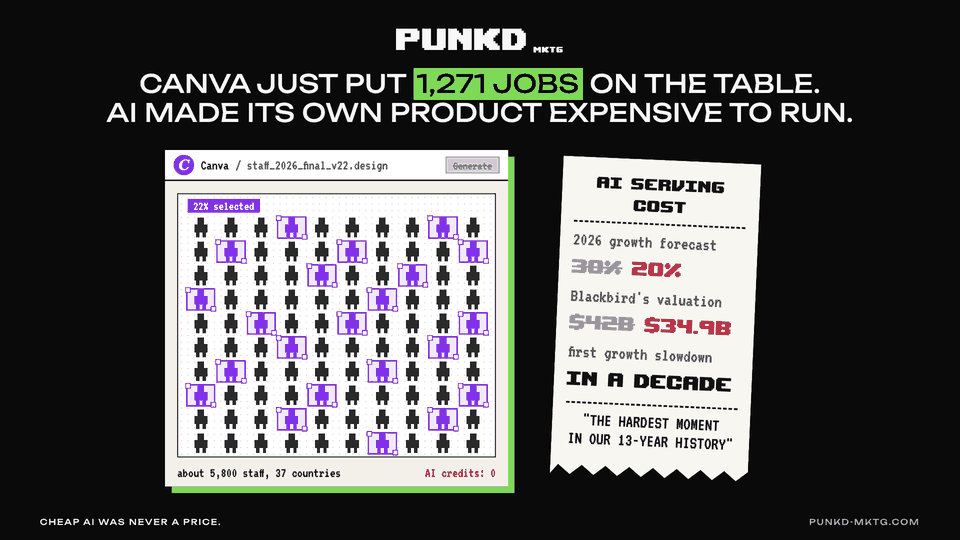
Canva just put 1,271 jobs on the table. AI made its own product expensive to run.
TL;DRAt a glance
- Canva is restructuring 22% of its staff: 1,271 people face layoffs, relocation or new roles.
- Its growth slowed for the first time in a decade.
- Demand for its AI tools raised serving costs, and it cut its 2026 growth forecast from 30% to 20%.
- Investor Blackbird marked its valuation down 17%, from $42 billion to $34.9 billion.
- xAI restricted Grok access over serving costs, so this is bigger than one design tool.
- Marketers should plan for AI tools that cost more or do less, and build a fallback now.
The tools your team uses for fast creative may be priced below what they cost to run. You will get the numbers behind Canva's cuts, what they suggest about AI pricing, and a short audit to run before someone else changes your limits.
WHAT CANVA ANNOUNCED
On 3 November, co-founder and CEO Melanie Perkins said Canva would restructure 1,271 roles, about 22% of its staff. Those people will lose their jobs, change roles or relocate to central hubs. She did not say how many would lose their jobs. She called it "the hardest moment in our 13-year history."
Canva employs around 5,800 people across 37 countries. It will bring product, growth and platform functions under one organisation, cut some specialist roles, reduce management layers and move more product teams to Sydney. Perkins said: "New technology is transforming what people can create, how they create it, and what they expect from the products they use."
WHY AI CAN MAKE A SOFTWARE COMPANY POORER
Normal software is cheap to serve. One more user barely adds to the bill. AI is different, because every prompt costs money in computing power. People in the trade call that the serving cost.
Adweek reports that demand for Canva's AI raised those costs, which led it to a more cautious outlook. In August it lowered its 2026 growth forecast from 30% to 20%. Blackbird Ventures marked its valuation down 17%, from $42 billion to $34.9 billion. Canva had been tipped for a 2027 IPO.
Bloomberg points to a second pressure: AI also lets people do more on their own without specialist programs. So a design tool can get squeezed from both sides. It pays more to serve each user, and some users need it less.
THIS IS NOT ONLY ABOUT CANVA
Social Media Today collected the same pressure elsewhere this week. Elon Musk told Grok users on 1 November that xAI had restricted access because "the cost of serving Grok Bot was unsustainably high relative to revenue." Reuters reported that OpenAI told investors its annualised revenue for September was almost $50 billion, after signalling that it was approaching $70 billion.
None of that proves your tool's price goes up next month. It does show the people selling AI are looking hard at what each user costs them.
WHAT TO EXPECT IF YOU BUY THESE TOOLS
This part is our opinion. When a product is priced below its running cost, the fix usually arrives as one of three things: a higher price, a smaller credit limit, or a feature moved up to a more expensive plan. Your workflow rarely gets a warning that suits your calendar.
A made-up example. Your team makes 200 ad variations a month and uses 200 AI credits to do it. In Black Friday week the limit drops to 100. You have not lost a tool. You have lost half your testing at the moment testing earns the most.
THE COST PER FINISHED ASSET
The number to track is not the subscription. Use this:
Cost per finished asset = (tool cost + human hours x hourly cost) ÷ assets that actually ran
Say a plan costs $300 a month, a designer spends 20 hours fixing outputs at $40 an hour, and 100 assets go live. That is ($300 + $800) ÷ 100 = $11 each. Notice where the money is. The credits are the small part, so a price rise hurts less than a tool that vanishes mid-campaign.
THE PUNKD TAKE
Cheap AI was never a price. It was somebody else's customer acquisition budget, and budgets end. We like AI and we use it. We just would not hand any one vendor the keys to our client's whole creative output. Build your creative on what earns, and make sure it still runs when the bill arrives.
STEAL THIS
- List every AI feature your content calendar depends on, with its current credit limit.
- Work out your cost per finished asset using the formula above.
- Keep master templates, fonts and brand files somewhere you can export from today.
- Run one test week at half your credits, and write down what breaks.
- Decide which assets get a human from the first draft, and protect that budget.
THE SHORT VERSION
- Canva's growth slowed, and serving AI costs real money.
- The same pressure is showing up across AI companies.
- Expect prices, limits or plans to move.
- Know your cost per finished asset, and keep a fallback.
What breaks in your team if your AI credits halve tomorrow?
If your creative only runs when one tool says yes, we can fix that.
Book Free ConsultationSources
- https://www.adweek.com/creativity/canva-to-cut-or-redeploy-22-of-staff-following-hardest-year-yet/
- https://www.moneycontrol.com/news/business/canva-announces-layoffs-job-changes-for-about-22-of-workforce-14068154.html
- https://www.socialmediatoday.com/news/companies-may-need-to-restrict-ai-use-to-manage-costs/873527/