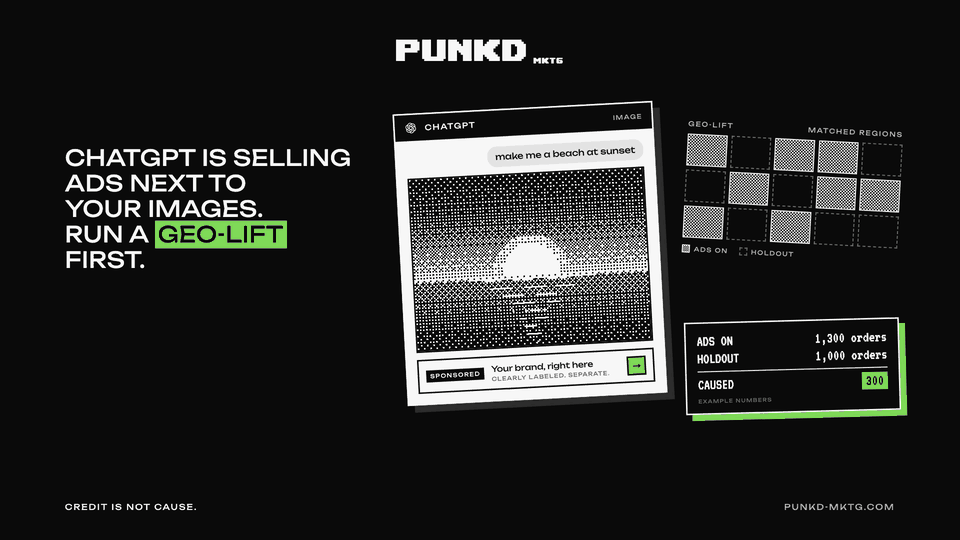
ChatGPT will sell ads next to your images. Run a geo-lift first.
TL;DRAt a glance
- OpenAI will test ads inside ChatGPT image generation, in the US, later in October.
- The bigger news is measurement: geo-lift tests now exist for ChatGPT ads.
- A geo-lift compares regions that see your ads with regions that do not.
- OpenAI's own case studies mix credited results and caused results. Learn to tell them apart.
- In one geo-lift, last-click missed most of the real orders. In other channels it over-claims.
- Run a holdout before you scale. Then scale hard.
OpenAI is putting ads next to the images people generate in ChatGPT. That will get the headlines. The part that should change how you spend is quieter: for the first time, advertisers can run proper incrementality tests on ChatGPT ads.
Below: what was announced, how to read the case studies without getting played, how a geo-lift works with real numbers, and the one setting to watch.
WHAT OPENAI ANNOUNCED
On 5 October 2026, OpenAI said it will test a new visual ad format during image generation in ChatGPT, starting later in October in the US with an initial group of advertisers. The ads show "product inspiration, product usage, or the experiences a product makes possible." OpenAI says they will be "clearly labeled" and kept "separate from the image being created", and that advertising "does not influence the answers ChatGPT provides."
The scale behind it: ChatGPT reaches 1.2 billion people a week, ads appear for users on the Free and Go plans, and the ads business passed a $1 billion annualized revenue run rate in under 200 days, with tens of thousands of advertisers, according to Marketing-Interactive's report on the announcement.
THE MEASUREMENT PART MATTERS MORE
OpenAI also announced a full measurement stack:
- Conversion data: easier connections through Hightouch, Tealium and LiveRamp.
- Attribution: ten partners, including AppsFlyer, Triple Whale, Adjust, DV Rockerbox and Northbeam.
- Advanced measurement: Fospha, Measured and INCRMNTAL.
- Geo-based incrementality, early stage: Haus, Measured and WorkMagic.
- Brand lift, early stage: Kantar and Cint.
- Brand safety pilots: DoubleVerify and Integral Ad Science.
Two terms. Attribution decides which ad gets credit for a sale. Incrementality asks whether the sale would have happened without the ad. They are not the same number, and the gap between them is where ad budgets go to die.
READ THE CASE STUDIES CAREFULLY
OpenAI shared results from early advertisers. Look at what each one actually measured.
WeightWatchers, measured by DV Rockerbox: attributed cost per acquisition on ChatGPT Ads was 15.3% below the brand's blended paid-search benchmark. Good sign, but it is credit, not cause.
Portland Leather Goods, measured by Triple Whale: 93% of visitors arriving from ChatGPT Ads were new visitors. Useful, but visitors are not buyers.
Fospha's analysis: ChatGPT generated 83% more revenue per 1,000 impressions than the paid social average. Again, attributed revenue.
Dose, measured by WorkMagic: a geo-lift study with a statistically significant lift, 67% of incremental purchases from net-new customers, and an estimated 2.3 times more incremental orders than last-click attribution captured.
Dose is the only one of the four that tested cause. And its result cuts the other way from what most people expect: last-click under-counted.
HOW A GEO-LIFT WORKS
You split your market into regions that look alike: similar size, similar sales history. Ads run in one group. The other group, the holdout, sees nothing. After a few weeks you compare.
Incremental orders = orders in ad regions minus orders in holdout regions (scaled to the same size).
Example: your ad regions sell 1,300 orders in four weeks. Your matched holdout regions sell 1,000. The ads caused 300 orders.
Now compare with what last-click reported. If it claimed 130 orders, it under-counted by about 2.3 times, like Dose. If it claimed 600, it doubled the truth, which is what usually happens with brand search and retargeting.
Cost per incremental order = ad spend ÷ incremental orders. Spend $15,000 for 300 caused orders and each real order cost you $50. That is the number to compare across channels.
THE SETTING TO WATCH
OpenAI also said view-through conversions now feed its advanced conversion optimisation. A view-through conversion is a sale from someone who saw an ad but did not click it. Counting those makes results look bigger, and letting them steer the algorithm can push spend toward people who were going to buy anyway. Check what you are optimising for.
THE PUNKD TAKE
A brand-new placement in front of this many weekly users, open only to a test group of advertisers at first, is a real opportunity. Early slots are often cheaper because the crowd has not arrived.
But a new platform reporting on itself is still a platform reporting on itself. The good news is OpenAI is handing you the tools to check. Use them. Run the holdout, find your real cost per new customer, then scale the hell out of what is real.
STEAL THIS
- Ask your OpenAI contact for a geo-lift with Haus, Measured or WorkMagic before real budget goes in.
- Pick matched regions and keep a few of them dark as your holdout for at least a few weeks.
- Report ChatGPT on cost per incremental order and cost per new customer, not attributed CPA.
- Check whether view-through conversions are steering your optimisation, and test with and without them.
- For the image format, brief creative that shows the product in use. People are in the middle of imagining something.
THE SHORT VERSION
- ChatGPT ads are coming to image generation in the US this month.
- Attribution gives credit. A geo-lift shows cause.
- Last-click can be wrong in both directions, so test.
- Scale ChatGPT on cost per incremental order, not on the dashboard.
Would you put money into ChatGPT ads without a holdout?
Most brands never test what their ads actually cause. We do.
Book Free ConsultationSources
- https://openai.com/index/new-chatgpt-ads-format-and-measurement/
- https://www.seroundtable.com/openai-visual-chatgpt-ad-format-42229.html
- https://www.relevantaudience.com/ai/chatgpt-ads-measurement-partners-image-ads/
- https://www.marketing-interactive.com/openai-adds-visual-component-to-chatgpt-ads
- https://techcrunch.com/2026/10/05/openai-launches-visual-ads-that-appear-alongside-image-generation-results/