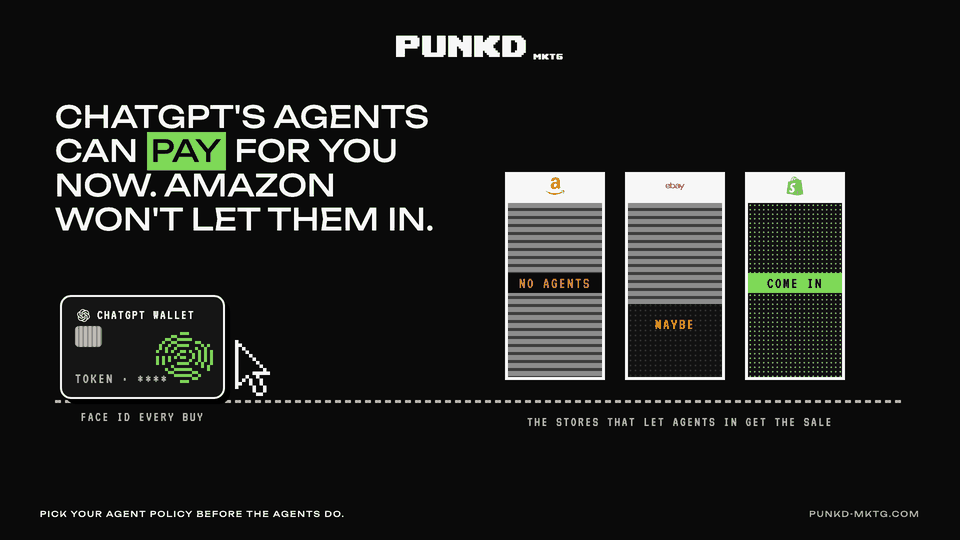
ChatGPT's agents can pay for you now. Amazon won't let them in.
TL;DRAt a glance
- On 13 November OpenAI started rolling out ChatGPT Wallet to Pro users in the US.
- ChatGPT's agents can now find and buy things, with a Face ID or fingerprint check each time.
- Amazon blocks outside AI agents from browsing or shopping.
- eBay restricts some agents, and United banned them from buying its tickets.
- Shopify opened a billion listings to agents.
- Every store now needs an agent policy and product data a machine can read.
- AI agents that shop for people just got a wallet, and some of the biggest stores are locking the door. Where your store stands decides whether you are in those sales at all.
- Below: what OpenAI launched, who is blocking and who is opening up, what agents actually read, and what to fix this month.
WHAT OPENAI LAUNCHED
ChatGPT Wallet started rolling out on 13 November to ChatGPT Pro subscribers in the US who are 18 or older, with a US billing address and an eligible American Express, Chase, Mastercard or Visa card. Once a card is in the wallet, ChatGPT's Dots agents can buy things in response to a prompt. They check in before checkout, and every purchase needs a biometric check like Face ID or a fingerprint.
The store never gets the real card number. Like Apple Pay, the wallet swaps it for a payment token. OpenAI says it expects people to eventually hand purchases over completely, with spending limits, categories or time periods set in advance.
An AI agent, in plain words: software that does a task for you, like browsing, comparing and buying, instead of only answering a question.
WHO IS BLOCKING THEM
Amazon blocks outside agents from browsing or shopping entirely. Target lets them browse in some cases and blocks them in others. eBay's user agreement bans "buy-for-me agents" and "LLM-driven bots" that place orders without human review. This month Meta's Muse agent found itself blocked on eBay, and eBay then said it was not a blanket ban: it allows "AI search, discovery and certain agent-assisted navigation" and blocks unauthorised scraping. United Airlines rewrote its contract to forbid AI agents from buying its tickets, seats and upgrades.
WHO IS OPENING UP
Shopify went the other way. It opened its catalogue of a billion listings so shoppers can set up agents to buy on their behalf.
The pattern: the giants that already own the shopping habit can afford to block. Everyone else needs every sale they can get.
WHAT AN AGENT ACTUALLY READS
An agent doesn't care about your hero video. It reads facts: the price, whether it's in stock, shipping cost and time, the returns policy, size and variant names. GEO (generative engine optimisation) means making sure AI tools can find, understand and recommend you. With agents it goes one step further: they also have to be able to finish the purchase.
Worked example: an agent is asked for "white sneakers, size 42, under $120, delivered by Friday." Store A shows the price, stock by size and delivery dates in clean product data. Store B hides delivery dates until the cart and opens a pop-up on load. The agent can confirm everything at Store A in one pass. At Store B it has to guess. Guess which one gets the order.
WHAT TO DECIDE
You have three choices: block agents, let them browse but not buy, or let them buy. Blocking protects your data and margins if you are already the default store. Letting them in gets you into sales you would never see otherwise. What you can't afford is no decision, with half your site blocking bots by accident and the other half breaking at checkout. OpenAI itself says that for agents to use the wallet, "websites need to ensure agents are not inadvertently blocked."
THE PUNKD TAKE
The big stores can afford to shut agents out because people go to them out of habit. Smaller brands can't. If an agent can't read your page or get through your checkout, you simply don't exist in that sale. Being easy to buy from is becoming the new SEO, and most checkouts were built for patient humans, not impatient software.
STEAL THIS
- Pick a policy this month: block, browse-only or buy, and write it down.
- Put price, stock, shipping, delivery dates and returns in structured data on every product page.
- Strip pop-ups from product pages and checkout, and test the flow without a mouse.
- Check your bot settings so you are not blocking AI tools by accident.
- Once a month, ask ChatGPT to find a product in your category and log which stores it picks.
THE SHORT VERSION
- ChatGPT's agents can now pay, with a biometric check each time.
- Amazon blocks agents, Shopify welcomes them, eBay sits in between.
- Agents buy from stores they can read and check out of easily.
- Decide your agent policy before the agents decide for you.
Would you let an AI agent buy from your store today, or block it?
If you want to be the store the agents pick, that's the work we do.
Book Free ConsultationSources
- https://www.theverge.com/ai-artificial-intelligence/1033425/openai-chatgpt-wallet
- https://www.theverge.com/tech/1030838/ebay-ai-agents-meta-muse-agentic-shopping
- https://thepaypers.com/payments/news/ebay-restricts-third-party-ai-agents-including-metas-muse
- https://ppc.land/united-bans-ai-agents-from-bookings-as-brussels-targets-paid-ai-picks/