ChatGPT stopped quoting summaries. It wants the source now.
TL;DRAt a glance
- ChatGPT now cites the sources that produce facts, not the sites that summarise them.
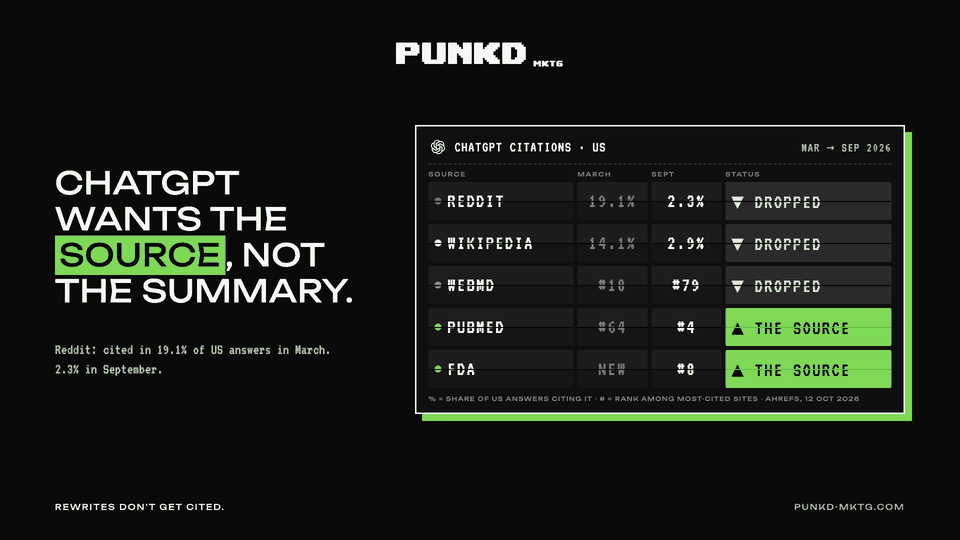
- Reddit fell from 19.1% of US ChatGPT answers in March 2026 to 2.3% in September.
- PubMed jumped from 64th to 4th most cited. WebMD dropped from 18th to 79th.
- When ChatGPT searches inside one website, it mostly searches brand sites.
- Its hidden searches ask for "official", "price", "reviews" and "specifications" more and more.
- Your own facts, tests and data now beat rewritten content in AI answers.
- AI search changed what it trusts. If your content repeats what others said, ChatGPT is learning to skip you and quote the original.
- Below: the data, how ChatGPT searches behind the scenes, and five things to change this month.
WHAT GEO MEANS NOW
GEO (generative engine optimisation) means getting your brand cited inside AI answers from ChatGPT, Gemini, Perplexity or Claude. AEO (answer engine optimisation) is the same idea for any tool that gives one answer instead of a list of links.
For two years the playbook was volume: get mentioned in as many places as possible, especially Reddit and Wikipedia, because AI tools quoted them all the time. That playbook just aged badly.
THE DATA: SUMMARIES OUT, SOURCES IN
On 12 October 2026, Ahrefs published a study of ChatGPT citations in the US from March to September 2026, covering 2.4 to 3.8 million answers a month.
- Reddit: cited in 19.1% of answers in March, 2.3% in September. Down 88%.
- Wikipedia: from 14.1% to 2.9%. Down 80%.
- YouTube: down 27%.
- PubMed, the US database of medical research papers: from the 64th most-cited site to the 4th.
- The FDA, the US food and drug regulator, entered the list at 8th.
- WebMD fell from 18th to 79th.
Ahrefs checked about 25,000 prompts that appeared in both March and September, and the shift held. Its conclusion: ChatGPT "seems to be moving from sites that summarize information to the sources that produce it."
One honest caveat, from Ahrefs itself: citation rank is not traffic. But in AI search, being the cited source is the new page one.
HOW CHATGPT SEARCHES BEHIND THE SCENES
When ChatGPT needs fresh information, it runs extra searches in the background. These are called fan-out queries: one question from you becomes one or more hidden searches.
Ahrefs analysed 66.6 million free, logged-out ChatGPT answers from August and September 2026, with 15 million fan-outs.
- 14.4% of answers triggered a web search.
- 6.8% of fan-outs were "site:" searches, meaning a search inside one specific website.
- Among the roughly 160 sites searched most this way, 75.9% of those searches went to brand sites. The top five: apple.com, ikea.com, nike.com, adidas.com and samsung.com.
In plain words: when ChatGPT wants a product fact, it goes to the brand's own website and looks it up.
WHAT IT IS ASKING FOR
The words inside those hidden searches show what ChatGPT wants:
- "official" appeared in 13.1% of English fan-outs in September, up from 10.1% in August.
- "price" rose from 6.04% to 8.88% in one month.
- "reviews" grew by about a third.
- "specifications" entered the top 50 words for the first time.
In a separate test of 20,000 US prompts, 84.4% of answers to factual questions cited at least one official source. For comparison questions ("X or Y?"), it was 68.3%.
So on facts, ChatGPT wants it straight from the source. On comparisons, there is still room for third parties, but less every month.
A WORKED EXAMPLE
Say you sell running shoes. A buyer asks ChatGPT: "Is the X Runner good for flat feet, and what does it cost?"
ChatGPT may search "X Runner official price" and "X Runner specifications", then run a site: search on your domain. If your product page loads the price with a script, shows the specs as an image and says nothing about flat feet, there is nothing to quote. A blog that summarised your page last year might get cited instead. Or your rival's clear page wins the answer.
Now fix it: price in plain text, a specs table in HTML, a short "who it's for" section with your own fit test. You just became the source.
THE PUNKD TAKE
Most brands spent the last two years buying content that rewrites somebody else's research. Ten "ultimate guides", zero new facts. It was cheap filler for Google. For ChatGPT, it is now invisible.
The brands that win AI answers will be the ones with something nobody else has: their own numbers, their own tests, their own product truth, written so a machine can read it. That is harder than rewriting a listicle. That is exactly why it works.
STEAL THIS
- Put prices, specs, sizes, stock and policies in plain HTML text on your product pages. No tables as images, no hidden tabs.
- Create an "official" page for every core question buyers ask: pricing, comparisons with named rivals, who it is for, returns.
- Publish one original asset a month: a test, a dataset, a customer survey with its method.
- Stop treating Reddit seeding (paying people to mention you there) as your AI strategy. Reddit's citation share dropped 88% in six months.
- Every month, run your top 20 buyer questions in ChatGPT and log which sites it cites. Fix the gaps.
THE SHORT VERSION
- ChatGPT now cites sources, not summaries.
- Reddit and Wikipedia citations collapsed; PubMed, the FDA and brand sites rose.
- ChatGPT searches brand sites directly and asks for "official", "price" and "specifications".
- Your own facts, in plain text, are your new SEO.
What does your website say that no other website could say?
Most brands are invisible in AI answers and do not know it yet. We check.
Book Free Consultation