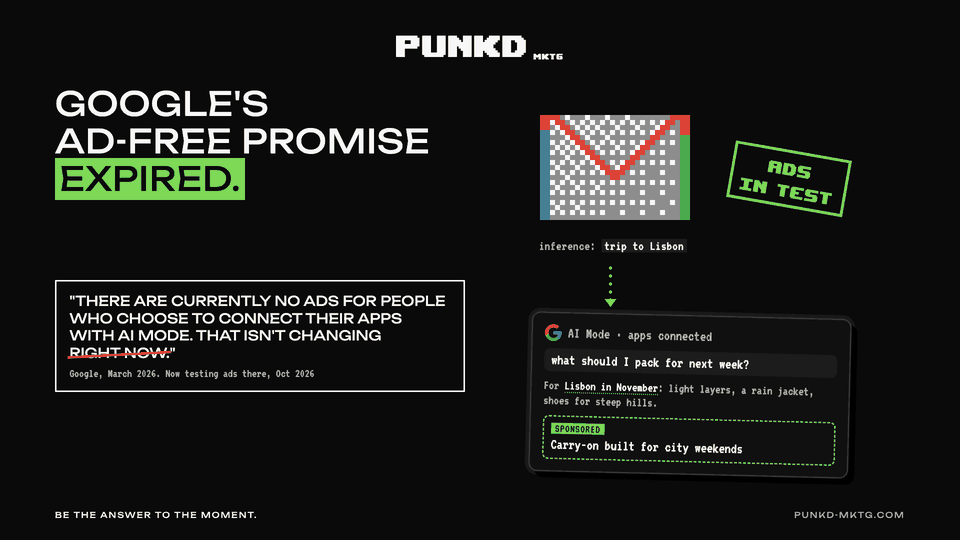
Google said AI Mode with your Gmail connected would stay ad-free. Now it's testing ads there.
TL;DRAt a glance
- In March, Google said AI Mode with connected apps had no ads and that wasn't changing "right now".
- On 16 October Google said it is starting to test ads for exactly those users.
- Ads won't be based directly on your Gmail or Photos, but on summaries and inferences from them.
- Advertisers never see anyone's connected apps, and sensitive categories stay off limits.
- The new targeting signal is the situation a person is in, not just their query.
- Build pages and ads for real-life situations, because that is what the AI now reads.
Google has reversed one of its cleanest promises about AI search. The version of AI Mode that reads your Gmail and Photos was meant to be ad-free. It is now getting ads.
Below: what Google said then, what it says now, what the new ads can use, a worked example, and what to build.
- WHAT PERSONAL INTELLIGENCE IS
- AI Mode is Google's chat-style search. Personal Intelligence is a setting inside it: people connect apps like Gmail and Google Photos, and AI Mode uses that information to give answers that fit their life. Ask what time your flight leaves and it can find the booking. Ask what to pack and it can know where you are going.
- WHAT GOOGLE SAID IN MARCH
- Google told Anu Adegbola: "There are currently no ads for people who choose to connect their apps with AI Mode. That isn't changing right now." It added that "in the future, we anticipate that ads will operate similarly for people who choose to connect their apps with AI Mode."
- WHAT GOOGLE SAYS NOW
- On Friday 16 October, Google told Search Engine Land: "Google is starting to test ads in AI Mode in Search for users who connect their apps through Personal Intelligence, reversing its earlier ad-free approach to the experience."
The help page was updated too. Its answer to whether your Gmail inbox or Photos library will be used to serve ads: "Ads will not be based directly on your Gmail inbox or your Google Photos library." But AI Mode "may reference summaries, excerpts and inferences from these sources to personalize your experience and do things for you. That same info may be used to show you ads, so they are even more helpful for you."
Two limits stay in place. Advertisers do not get access to anyone's connected apps. And Google says it does not personalise ads on sensitive categories such as race, religion, sexual orientation or health.
- WHAT THE NEW SIGNAL REALLY IS
- Google describes AI Mode ads as relevant to "your query, the context of the response and your interests". The query is the old world. The context is the new one. An inference (a conclusion the AI draws from your data, like "this person is travelling next week") can now shape both the answer and the ad next to it.
You cannot target that inference. Nobody can buy "people with a Lisbon booking in Gmail". What you can do is be the obvious fit for the situation once Google works it out.
- A WORKED EXAMPLE
- Say someone has a flight to Lisbon in their Gmail and asks AI Mode: "What should I pack for next week?" The answer can draw on the trip. Now picture two advertisers. One has a page called "What to pack for Lisbon in November", with weather, a list and the right bag. The other has a page called "Buy suitcases online". Google says the ad follows the query, the response and interests. The first page matches all three. The second matches one word.
- THE PUNKD TAKE
- The privacy argument will get the headlines. For marketers, it is not the story. The story is that the richest context in advertising, people's own plans, is now feeding the answers ads sit next to, and you cannot buy it directly. You can only be the best answer to the moment it reveals. Brands still writing ads for keywords will be talking past the person.
- STEAL THIS
- 1. List the 10 real situations your buyers are in right before they need you: trips, moves, weddings, launches, renewals.
- 2. Build one page per situation that answers it better than anyone else.
- 3. Rewrite ad copy for the situation, not the keyword.
- 4. Read your search terms report monthly for long, question-style searches and turn the best into pages.
- 5. Track which situation pages win the most conversions and build more like them.
THE SHORT VERSION
- Google reversed its ad-free promise for AI Mode with connected apps.
- Ads can now use inferences from Gmail and Photos, not the raw content.
- The new signal is the buyer's situation, not just their words.
- Build pages and ads for situations, and be the obvious answer.
Which situation is your buyer in right before they need you, and do you have a page for it?
We build search for the way people ask now.
Book Free Consultation