Google's new Search model breaks one question into many. Answer the pieces.
TL;DRAt a glance
- Google made Gemini 4 Hydrogen the default model in AI Mode on 12 November.
- It also handles the hardest questions in AI Overviews, for all users, globally.
- Google calls it "the biggest model upgrade to Search yet".
- Its improved query fan-out splits one question into searches across every subtopic.
- Google says that links people to sites they "previously might not have discovered".
- The play: answer the sub-questions buyers never type, one clear page or section each.
- Google's AI answers now run on a stronger model that breaks every question into smaller ones and searches each of them. Every one of those smaller searches is a way into the answer. Most brands only built one.
- Below: what changed, how fan-out works with a worked example, why the timing matters, and how to map your own sub-questions.
WHAT GOOGLE SHIPPED
On 12 November, Google rolled out Gemini 4 Hydrogen in Search for all users, globally. Robby Stein of Google: "It's now the new default model in AI Mode & being used for your hardest questions in AI Overviews." Nick Fox of Google called it "the biggest model improvement to Search yet."
AI Mode is Google's chat-style search tab. AI Overviews are the AI summaries that sit above the normal results. AEO (answer engine optimization) means getting your brand cited inside those answers.
Google lists four upgrades: better understanding of intent, improved query fan-out and linking, more visual responses (images, structured responses, comparison tables and custom tools) and richer language understanding across AI Mode languages.
QUERY FAN-OUT, IN PLAIN WORDS
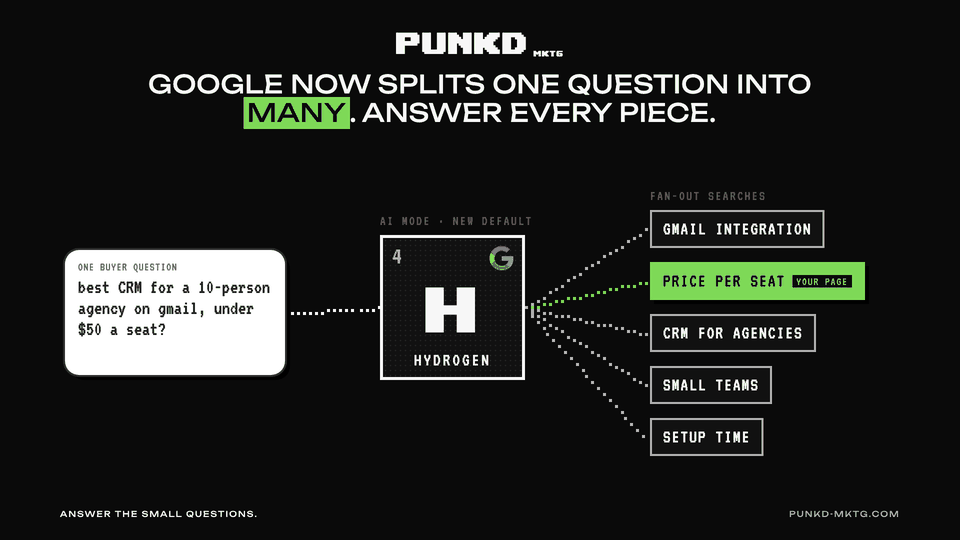
Fan-out is when the AI takes one question, runs several searches behind the scenes, one per subtopic, and stitches the answer together. Google says Hydrogen does this "across all the relevant subtopics", connecting people "to a broader range of helpful links than before."
Worked example (hypothetical): someone asks, "Best CRM for a 10-person agency that already uses Gmail, under $50 a seat?" The AI might search separately for CRMs that integrate with Gmail, CRM pricing per seat, CRMs built for agencies, CRMs for small teams and setup time. That is five searches and five chances to be cited.
A brand with one "Best CRM" page competes for one of them. A brand with a clear answer to each sub-question competes for all five.
WHY THE TIMING MATTERS
Hydrogen landed in the middle of Google's November 2026 core update, the broad ranking change that started rolling out this month. Search Engine Roundtable reads Hydrogen as mainly affecting AI Overviews and AI Mode rather than core rankings, while noting Google has said it feeds core search signals into its AI features.
At the same time, Google is testing removing the AI Mode tab from some results pages and the "Ask anything" box from some AI Overviews. The surface keeps changing. The constant is that the AI still needs pages that answer narrow questions clearly.
HOW TO MAP YOUR SUB-QUESTIONS
Take your 10 most valuable buying questions. For each one, list the 5 to 8 smaller questions a careful buyer needs answered: price, fit for a specific team size or industry, integrations, comparisons, setup time and risks.
Then check each sub-question against your site. Is there a page, or a clearly labelled section, that answers it in the first two sentences, with a number or a fact?
Add structure an AI can lift: comparison tables, pricing tables, and short FAQ blocks that use real buyer questions as headings.
Finally, ask your sub-questions in AI Mode yourself and note who gets cited. Those are the pages you are really competing with.
THE PUNKD TAKE
Most brands are still fighting over one big keyword. Google's AI now asks the small questions on the buyer's behalf, and the brands that answer the boring specifics (price per seat, works with Gmail, set up in a day) get pulled into the answer. Specific beats famous.
STEAL THIS
- List your 10 most valuable buying questions and break each into 5 to 8 sub-questions.
- Answer each sub-question in the first two sentences of a page or section.
- Turn your pricing and comparison information into simple tables.
- Test your sub-questions in AI Mode every month and log who gets cited.
- During the core update, add answers to pages instead of deleting or rewriting them in a panic.
THE SHORT VERSION
- Gemini 4 Hydrogen now powers AI Mode and the hardest AI Overviews.
- Its fan-out turns one question into many searches.
- Every sub-question is a chance to be cited.
- Answer the small, specific questions clearly and in a structure an AI can lift.
Which sub-question about your product does your website still not answer?
We help brands become the answer, not just a result.
Book Free ConsultationSources