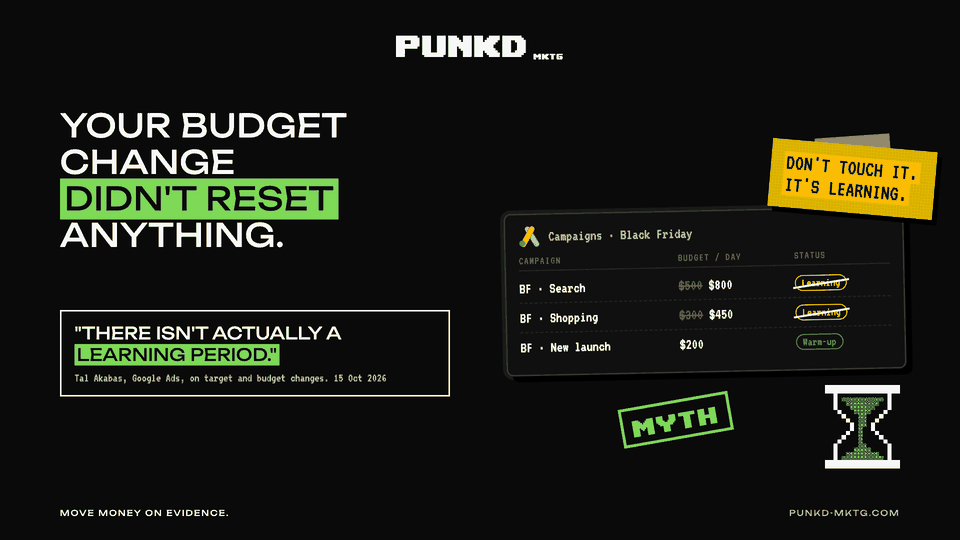
Google says budget changes don't trigger a learning period. Stop freezing campaigns.
TL;DRAt a glance
- On 15 October, Google Ads' Tal Akabas said target and budget changes on established campaigns cause no learning period.
- Google says its system scales bids in proportion to your new target, and nothing resets in the back end.
- Brand-new campaigns are the exception: that is where some learning can happen.
- The dip you saw after past changes was most likely conversion lag, not a reset.
- Google has not published data for this, so check it on your own account.
- Judge every change after one full conversion cycle, not after two days.
The "learning period" is the most expensive excuse in paid search. Google just said it does not apply when you change the target or budget of a campaign that is already running.
Below: what Google said, the one case where learning is real, why your numbers dipped anyway, and how to change budgets this Black Friday without fooling yourself.
WHAT THE LEARNING PERIOD MYTH SAYS
Smart Bidding is Google's automated bidding. You give it a goal, like a target CPA (cost per acquisition: what you are willing to pay for one sale or lead) or a target ROAS (return on ad spend: revenue per dollar spent), and it sets the bid in every auction.
The myth: touch that target or the budget and the system "resets", then spends days relearning while performance drops. That belief is why so many advertisers freeze campaigns in busy periods and refuse to react to what the numbers tell them.
WHAT GOOGLE SAID ON 15 OCTOBER
On Google's Ads Decoded podcast, hosted by Ads Product Liaison Ginny Marvin, Google Ads product leader Tal Akabas was asked about it. His answer for established campaigns: "there isn't actually a learning period."
He explained the mechanics: "The Google Ads back end system will scale bids directly in proportion to your target changes." In plain words, you move the target, the bids move with it. And, in his words, "nothing's going to reset in the back end and throw everything off." He also said there is "a lot of misinformation" about what affects learning.
THE ONE PLACE LEARNING IS REAL
New campaigns. A campaign with no history has nothing to scale from, and Akabas said "that is where some learning period can take place."
So the rule is simple. Changing a running campaign: no reset. Launching a new one: expect a warm-up.
WHY YOUR NUMBERS DIPPED ANYWAY
If you have ever changed a target and watched results fall for a few days, you were probably looking at conversion lag: the time between a click and the sale it leads to.
Say your buyers take about 7 days from click to purchase. On Monday you raise your target CPA from $50 to $60. By Wednesday the dashboard shows fewer conversions than last week. Nothing is broken. Monday's clicks have simply not turned into sales yet. A week later they arrive, and the dip disappears.
Google's own earlier advice fits this. In March, Google's Kristina Park suggested waiting at least one conversion cycle before making another target change. In June, Google advised waiting one to two conversion cycles after a budget increase before judging results. Both are about measuring a change properly, not about the system relearning.
ONE HONEST CAVEAT
Google has not published data to back the claim, and Akabas did not say how big a change can be before proportional scaling stops holding. Take it as Google's word, then check it on your own account.
HOW TO CHANGE BUDGETS WITHOUT FOOLING YOURSELF
Find your conversion cycle first: how many days your conversions usually take after the click. That number tells you how long to wait before you judge anything.
Then make changes you can read: one change per campaign at a time, written down with the date, and left alone for one full cycle. Compare the full cycle after the change with the full cycle before it, not Tuesday with Monday.
THE PUNKD TAKE
"Don't touch it, it's learning" has protected a lot of lazy account management. It sounds technical, it buys time, and nobody checks it. Now Google itself says it does not apply to the changes advertisers make most often.
We have managed $3.5M+ in ad spend on Meta and Google since 2023. We would rather move money on evidence than sit still because of a myth, especially in the weeks when moving money matters most.
STEAL THIS
- Pull your days-to-conversion data. That is your conversion cycle.
- Change targets and budgets on running campaigns when the business needs it, Black Friday included.
- Judge every change only after one full conversion cycle.
- Launch any brand-new Black Friday campaigns early: those still need a warm-up.
- Keep a dated change log, so you can test Google's claim on your own numbers.
THE SHORT VERSION
- Google says target and budget changes on running campaigns cause no learning period.
- New campaigns are the only place real learning happens.
- Short dips after a change are usually conversion lag.
- Wait one full conversion cycle, then judge.
What did you not change last Black Friday because someone said "it's learning"?
If your account is still frozen by a myth, we will show you what it is really doing.
Book Free Consultation