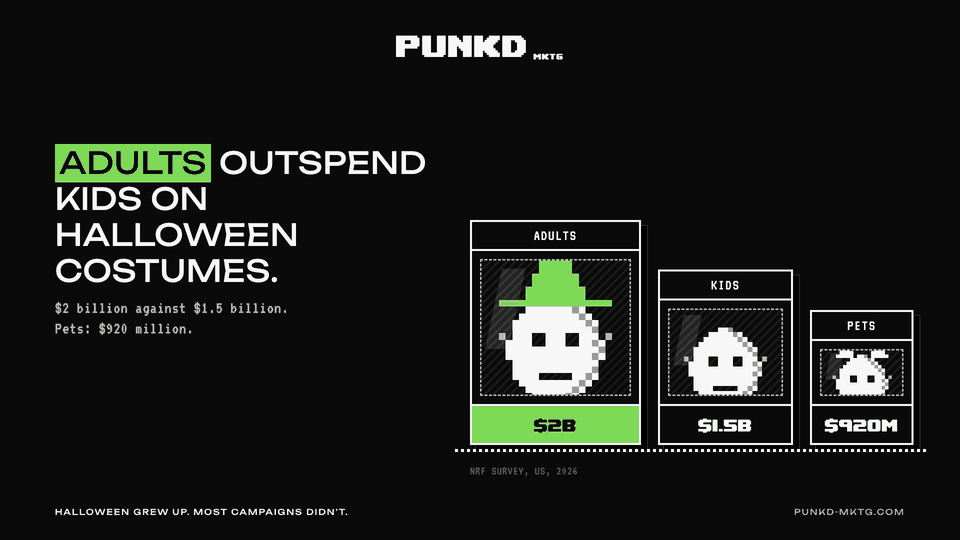
Adults will spend $2 billion on Halloween costumes. Kids, $1.5 billion.
TL;DRAt a glance
- Americans plan to spend $13.5 billion on Halloween this year, about $115 a person (NRF).
- Adults will spend $2 billion on costumes, kids $1.5 billion and pets $920 million.
- About 2 million adults plan to dress as Batman; in 1966 one company sold about 2 million Batman costumes to kids.
- 49% planned to start shopping in September or earlier, up from 34% in 2016.
- Online search is the top source of costume ideas at 32%, the lowest in a decade.
- The lesson for every seasonal moment: check who really buys, start earlier, and be where the idea forms.
- Halloween stopped being a kids' holiday a while ago, and the spending proves it. Adults now outspend children on costumes, and pets are close behind.
- Below: the numbers, what changed, and a simple way to check whether your own seasonal campaigns are talking to the wrong person.
THE NUMBERS
The National Retail Federation (NRF) surveyed 7,889 Americans from 1 to 9 September 2026. Its forecast:
- Total Halloween spending: $13.5 billion, close to last year's record $13.1 billion.
- Average spend: $115.14 a person.
- Candy: $4.1 billion. Decorations: $4.3 billion. Costumes: $4.4 billion.
- 74% plan to celebrate, up from 68% in 2019.
ADULTS ARE NOW THE BIGGEST COSTUME BUYERS
Inside that $4.4 billion of costumes: adults $2 billion, children $1.5 billion, pets $920 million.
The most popular adult costumes: witch (4.8 million people), vampire (4.2 million), Batman (2 million), Spider-Man (1.5 million) and ghost (1.4 million).
Read that list again. Two of the top five adult costumes are superheroes most people met as kids.
FROM 2 MILLION BATMAN KIDS TO 2 MILLION BATMAN ADULTS
In the 1960s, Halloween costumes were a children's business. Ben Cooper of Brooklyn sold costumes for about $1 to $3 and, according to The Hustle, about 2 million Batman costumes in 1966 alone. The buyers were parents, the wearers were kids.
Sixty years later, about 2 million American adults plan to be Batman. Same character, same scale, different buyer. Our read: the kids who wore the plastic mask kept the habit, and now they pay for it themselves.
THE SEASON STARTS IN SEPTEMBER
49% of shoppers planned to start buying in September or earlier, up from 34% in 2016. For half the market, the decision is made weeks before the date most brands plan their push around.
A simple check: take last season's sales and split them by week. Say you sold $100,000 of seasonal stock and $45,000 of it sold more than three weeks before the day. That is your real season. Your media plan should start when your sales do, not when your calendar says.
SEARCH IS LOSING THE IDEA STAGE
Online search is still the top source of costume ideas, but its share fell to 32% from 37% last year: the lowest in a decade. Retail stores and costume shops come second at 26%, and are the top source for decoration ideas at 31%.
Our read: by the time people search, many have already decided what they want. If you only show up in search, you are fighting for the last step of a decision that started somewhere else: a store shelf, a feed, a friend's photo.
HOW TO USE THIS FOR BLACK FRIDAY AND CHRISTMAS
Buyer share = sales from one buyer type ÷ total sales. Work it out for your last seasonal peak: adults buying for themselves, adults buying gifts, kids, pet owners. If one group is 40% of sales and 10% of your creative, your campaign is talking to the wrong person.
THE PUNKD TAKE
Most brands market the holiday they remember, not the one their customers live. Halloween is a grown-up spending event now, with a pet aisle. Nothing wrong with the kids. They just are not the ones paying anymore. Check which of your "kids'" moments grew up too.
STEAL THIS
- Pull last season's orders and split them by buyer: age, gift or self-purchase, pet owners.
- Work out your buyer share and compare it with who appears in your ads.
- Move your seasonal launch a month earlier and watch whether early sales move with it.
- Put adults in the creative when adults pay.
- Do not let search be your only seasonal channel: be where the idea forms, in stores, feeds and creators' posts.
THE SHORT VERSION
- Adults outspend kids on Halloween costumes: $2 billion against $1.5 billion.
- Half of shoppers start in September or earlier.
- Search is losing its grip on where ideas start.
- Check who really buys before you plan the next season.
Which of your seasonal campaigns is still talking to the wrong person?
We help brands find the buyer who actually pays, then scale what earns.
Book Free Consultation