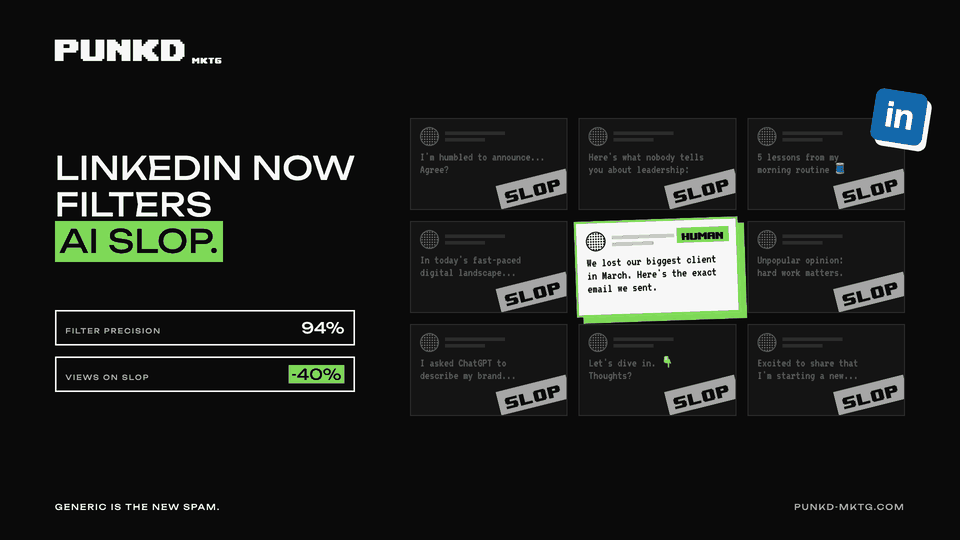
LinkedIn now checks every post that travels for AI slop. Be specific.
TL;DRAt a glance
- LinkedIn's AI-slop classifiers now cover every post distributed beyond your immediate network.
- LinkedIn says they catch slop with 94% precision.
- Content classed as slop already got 40% fewer views by August 2026.
- LinkedIn defines slop as generic and/or repetitive posts with no real insight. Using AI is not the target.
- More than 1 million people used the report-slop button within three weeks of launch.
- The fix is specificity: your own numbers, names, mistakes and opinions in the first two lines.
If your post reaches people outside your network, LinkedIn's slop filter has judged it first. Generic posts are now a reach problem, not just a taste problem.
Below: what LinkedIn changed, how the filter works, what counts as slop, and how to write posts that get through.
WHAT LINKEDIN CHANGED
On 8 October Tim Jurka, a VP of Engineering at LinkedIn, published how the company fights AI slop. The key line: LinkedIn has "recently expanded our classifiers to cover all posts that are distributed beyond your immediate network", with "94% precision at detecting AI-slop".
A classifier is a model that sorts content into buckets, in this case slop or not slop. Precision is how often it is right when it says "slop". At 94%, six flagged posts in every 100 are false alarms. The other 94 really are slop, by LinkedIn's standard.
"Beyond your immediate network" matters most. Your first-degree connections may still see a sloppy post. The people who do not know you yet, the ones you are actually posting for, are where the filter sits.
HOW THE FILTER WORKS
LinkedIn uses a teacher and student setup. Large "teacher" models are designed to keep up with new slop patterns. They produce training data that teaches smaller "student" models, which are cheap enough to run across the feed and can pick up new patterns quickly.
On top of that, AI agents review content against a written policy. When an agent hits a case its policy cannot settle, it sends it to human reviewers, and the policy is updated from their answer.
In plain terms: the moment a new template hook goes viral and gets copied a thousand times, the teacher models can spot the pattern and push it down to the fast models.
WHAT COUNTS AS SLOP
LinkedIn defines AI slop as "generic and/or repetitive posts that added no real insight", according to Social Media Today's report. Jurka's own post calls it "the generic, repetitive content" and "low-effort, AI-generated content".
Notice what is missing. Nothing in the update says that using AI to write is banned. The two words that matter are generic and repetitive. A post written entirely by a human can be slop. A post drafted with AI and filled with real numbers and a real opinion is not what this definition describes.
THE PROOF IT IS ALREADY BITING
As of August 2026, members were seeing 40% fewer views on content LinkedIn classifies as slop, compared with a few weeks earlier.
People are helping too. More than 1 million members used the report-slop button in less than three weeks after it launched in August, per Social Media Today. Every report is more training data.
A WORKED EXAMPLE
This one is hypothetical. Say your posts usually reach 10,000 people, 3,000 inside your network and 7,000 beyond it. If a post gets classed as slop and the reach beyond your network drops by the 40% LinkedIn reported, you lose 2,800 views from exactly the people who did not know you yet. That is where new buyers, hires and partners come from.
HOW TO WRITE POSTS THAT GET THROUGH
Open with something only you could write. A number from your own business, a result, a mistake, a decision. If a thousand other posts could open the same way, it is generic by definition.
Use real names, real figures and real dates. Specific detail is the opposite of slop.
Say one thing per post and say it once. Repetition is half of LinkedIn's definition, and that includes repeating yourself across a week of posts.
Take a side. An opinion someone could disagree with is the fastest proof a person wrote it.
THE PUNKD TAKE
Everyone is panicking that LinkedIn is banning AI. It is not. It is banning boring, and boring was never working anyway.
The feed has been drowning in the same five tips, the same fake vulnerable stories and the same "Here's what nobody tells you" openers. LinkedIn just admitted it can spot them. Founders and brands who write like humans with opinions now have an edge over everyone running the template.
STEAL THIS
- Rewrite your first two lines so they contain one fact only you know.
- Ban template hooks from your team's posts. Keep a list and check every draft against it.
- Add at least one real number, name or date to every post.
- Pick one idea per post and do not repeat it in the same week.
- Read the draft aloud. If it sounds like nobody in particular wrote it, rewrite it.
THE SHORT VERSION
- LinkedIn's slop filter now judges every post that travels beyond your network.
- It claims 94% precision, and slop already lost 40% of its views.
- The target is generic and repetitive content, not AI as such.
- Specific beats polished: your numbers, your names, your opinion.
Would your last post pass a 94% slop detector?
We write LinkedIn content with real numbers and real opinions.
Book Free Consultation