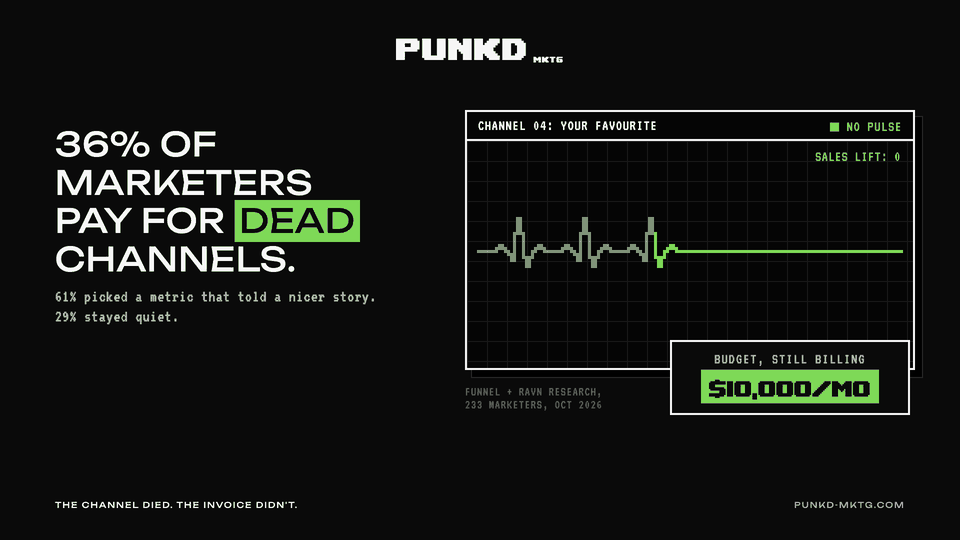
36% of marketers keep paying for channels they think are dead.
TL;DRAt a glance
- A Funnel and Ravn Research survey of 233 marketers says the industry is playing defence.
- 36% kept funding a channel they believed wasn't working.
- 61% picked a metric because it told a nicer story, and 29% stayed quiet about data they knew was wrong.
- Only 18% can clearly tell what each channel does for sales.
- The fix is a holdout test: switch a channel off somewhere and see if sales move.
- Dead channels survive on fear, not on results.
Marketers are wasting budget on purpose. Not because they're stupid, but because killing a channel feels more dangerous than funding a dead one.
Here is what the new survey found, why it happens, what a dead channel really costs you, and the test that tells you which of your channels are alive.
WHAT THE SURVEY FOUND
Funnel, a marketing data company, ran its fifth annual survey with Ravn Research and published it on 29 October 2026 under the title "Playing defense". It covers 233 in-house marketers and agency leaders, plus interviews with five agency bosses.
The defensive choices are the headline:
- 36% kept funding a channel they believed wasn't working.
- 60% chose a safer, more provable strategy over a riskier one they suspected would work better.
- 59% prioritised work because it was easier to measure.
- 58% rejected an idea because its impact couldn't be estimated in advance.
- 61% chose a metric because it told a more favourable story.
- 29% stayed silent when they knew data was wrong or misleading.
- 84% never experiment, or only occasionally.
One respondent summed up the mood: "I don't want to rock the boat. Get paid. Go home."
WHY SMART PEOPLE FUND DEAD CHANNELS
Pressure. 80% of in-house marketers feel at least moderate pressure to justify their value, and 58% say that pressure grew in the last year. Of those under pressure, 48% say it makes them less willing to take risks.
Weak measurement makes it worse. Only 18% can clearly determine each channel's impact. 49% rely mainly on platform-reported data and simple attribution. Attribution is the rulebook that decides which ad gets credit for a sale, and when Meta or Google marks its own homework, every channel looks alive. Only 10% have high trust in their attribution model.
Put those together and you get the report's sharpest line: "it's easier to punish a failed experiment than change a failing status quo." If a new test fails, it's your fault. If an old channel keeps failing quietly, nobody notices.
WHAT A DEAD CHANNEL REALLY COSTS
The waste isn't just the spend. It's what the money could have done somewhere else.
- Say you spend $50,000 a month across five channels, and one $10,000 channel adds nothing.
- Direct waste: $10,000 × 12 = $120,000 a year.
- Opportunity cost: if your best channel returns 3x, that same $120,000 could have brought $360,000 in sales.
So the dead channel isn't costing you $120,000. It's costing you $360,000 in sales you never made. That is the number to put in front of whoever is scared to cut it.
HOW TO FIND OUT WHICH CHANNELS ARE ALIVE
Use a holdout test. You switch a channel off for a group of customers or regions, keep it running for the rest, and compare sales. The difference is what the channel really adds. Not what the platform claims, what actually happens when it's gone.
- How to run one:
- Pick the channel you trust least.
- Choose a few comparable regions, cities or customer groups, and pause the channel there for two to four weeks.
- Keep everything else the same.
- Compare sales per region with your own numbers, from your shop or your CRM.
If sales in the paused regions barely move, the channel was taking credit for sales that happened anyway. Only 9% of teams in the survey combine methods like this with attribution and media mix modelling, so doing it at all puts you ahead.
THE PUNKD TAKE
The scariest number in this report isn't 36%. It's 29%: people who saw bad data and said nothing. Budgets don't die from one big mistake. They die from a hundred quiet ones that nobody wanted to point out. We typically find 18-30% of ad spend doing nothing at all, and almost every time someone in the room already suspected it.
STEAL THIS
- List every channel with one line next to it: what would we lose if we paused this for a month?
- Pick the channel you trust least and run a two to four week holdout in a few regions.
- Judge it on your own sales data, never on the platform's dashboard alone.
- Cut what shows no lift and move the money to your best channel.
- Make it safe to say "this isn't working" in your weekly meeting. Reward the person who finds the waste.
THE SHORT VERSION
- 36% of marketers fund channels they think are dead.
- Fear of blame keeps them alive, not results.
- A holdout test shows what a channel really adds.
- A dead channel costs you its budget plus the sales that money could have made.
Which channel in your budget would you be scared to switch off for two weeks?
We find the spend that's doing nothing and move it to what sells.
Book Free Consultation