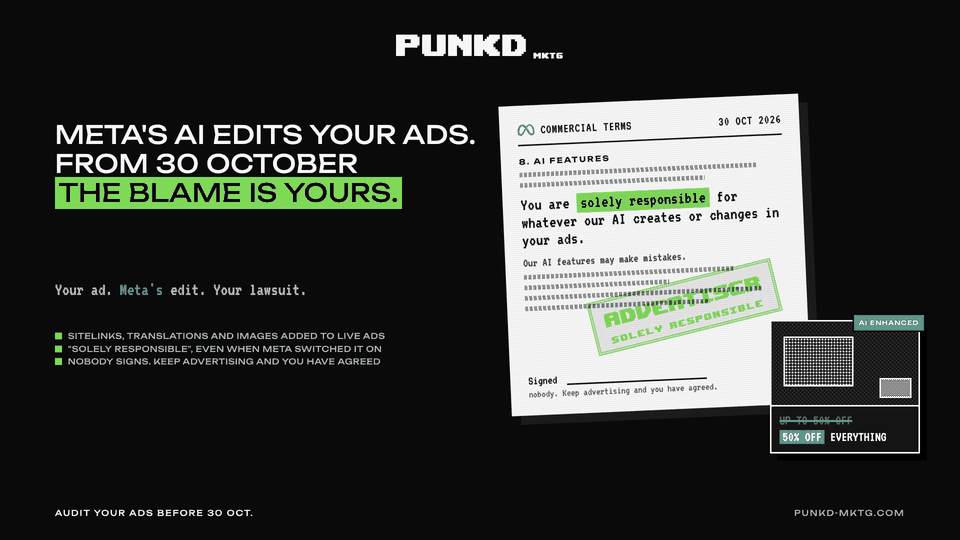
Meta's AI edits your ads. From 30 October the blame is yours.
TL;DRAt a glance
- Meta's revised Commercial Terms take effect on 30 October 2026 with a new section called "AI Features".
- Advertisers become "solely responsible" for whatever Meta's AI creates or changes in their ads, including features Meta switches on itself.
- Agencies say Advantage+ tools already add sitelinks, translate copy and generate images in live campaigns nobody asked to change.
- Bookshop.org found an AI illustration in its own ad and has switched every Meta AI ad feature off.
- Nobody signs anything: keep advertising after 30 October and you have accepted the terms.
- Below: what the terms say, what the tools are doing, and a four-step check to run before the date.
- Meta's AI can now edit your ads on its own, and from 30 October its contract says the result is your fault.
- Here is what changed, what it is already doing to live campaigns, and what to do about it this week.
WHAT THE NEW TERMS SAY
Adweek's Trishla Ostwal read Meta's revised Commercial Terms and found a new section titled "AI Features". It does not exist in the version in force today. Under it, businesses that run ads on Facebook and Instagram are "solely responsible" for whatever Meta's AI features create or change in their ads. The language covers features Meta turns on by itself, not just the ones you tick.
The same section concedes that those features "may make mistakes and may not always produce accurate, complete, or suitable results."
Her summary: "from Oct. 30, if Meta's AI messes up your ad, that's on you."
There is no signature. PPC Land, which checked the terms currently in force, notes that continued use after notice counts as acceptance. The banner on Meta's terms page says the updates come into effect on 30 October 2026.
WHAT META'S TOOLS ARE ALREADY DOING
This is not a future risk. Buyers told Adweek that Meta's AI is already reworking their ads without asking. Agencies described Advantage+ adding sitelinks, translating copy and generating images inside live campaigns. One agency, Exverus, pulled running ads to strip those changes out.
Bookshop.org, the online bookseller, found an illustration in one of its Meta ads that nobody at the company had made. An account update had opted the business into a generative AI feature, which then decorated an ad people had designed. On Threads the company wrote that the ad was "'enhanced' (or ruined, really) by Meta without our knowledge." It has since turned off all of Meta's AI ad features.
A sense of the technology: on 19 October three Meta engineers explained why the company took autonomy away from one of its own AI agents. "It worked in demos. In production, it started hallucinating." Meta split that agent into 14 specialists behind a fixed router. The ad tools editing your creative belong to the same family.
WHO CARRIES THE RISK NOW
An AI edit is not a design problem. Think about what an automated change can do:
- A translated headline that turns "up to 50% off" into "50% off".
- A generated product image that shows a colour you do not sell.
- A sitelink to a page you retired last month.
- A claim rewritten into something your legal team never approved.
Every one of those is a complaint, a refund or a regulator's letter. From 30 October the contract points them at you, even if Meta's tool made the change and you never opted in.
Meta reported $64.6 billion in third-quarter revenue the same week, per Adweek. The automation that produces that revenue is the automation whose mistakes you now own.
WHAT TO CHECK IN YOUR ACCOUNT BEFORE 30 OCTOBER
- Open every active campaign and look at the Advantage+ creative settings. Switch off text, image and translation enhancements you did not choose.
- Check account-level defaults. Bookshop.org's problem came from an account update, not a campaign setting.
- Screenshot your live ads from a real feed, not from Ads Manager previews, and compare them with what you uploaded.
- Decide who approves AI edits. Treat an AI-changed ad like a new creative: it needs a named person's sign-off.
THE PUNKD TAKE
Meta sells the automation, keeps the ad revenue and hands you the risk. That is the trade on the table, and most advertisers will accept it by doing nothing.
We like automation when it works harder than the team. We do not like it when it works behind the team's back. Across the $3.5M+ in ad spend we have managed on Meta and Google since 2023, the gains came from killing what did not work and scaling what did, not from letting a tool rewrite the offer without telling anyone.
Switch the features off, then turn them back on one at a time where you can measure the lift. Anything else is gambling with your brand's claims.
STEAL THIS
- Before 30 October, audit every campaign and the account defaults for generative features. Turn off what you did not choose.
- Put a weekly live-ad check in the calendar: screenshot from the feed, compare, log every change Meta made.
- Write an AI-edits rule into your agency and client contracts: who approves, who pays when a tool gets it wrong.
- Test one enhancement at a time against a control. Keep only what lifts sales, not clicks.
THE SHORT VERSION
- From 30 October, Meta's AI edits to your ads are your responsibility, even when Meta switched them on.
- Agencies are already finding sitelinks, translations and images they never asked for in live ads.
- Audit campaign and account settings now, and screenshot live ads weekly.
- Automation that works behind your back is not optimisation. It is risk you did not price.
If Meta's AI put a wrong claim in your ad tomorrow, would you notice before a customer did?
We read the terms so you do not have to, and we fix what the tools break.
Book Free Consultation