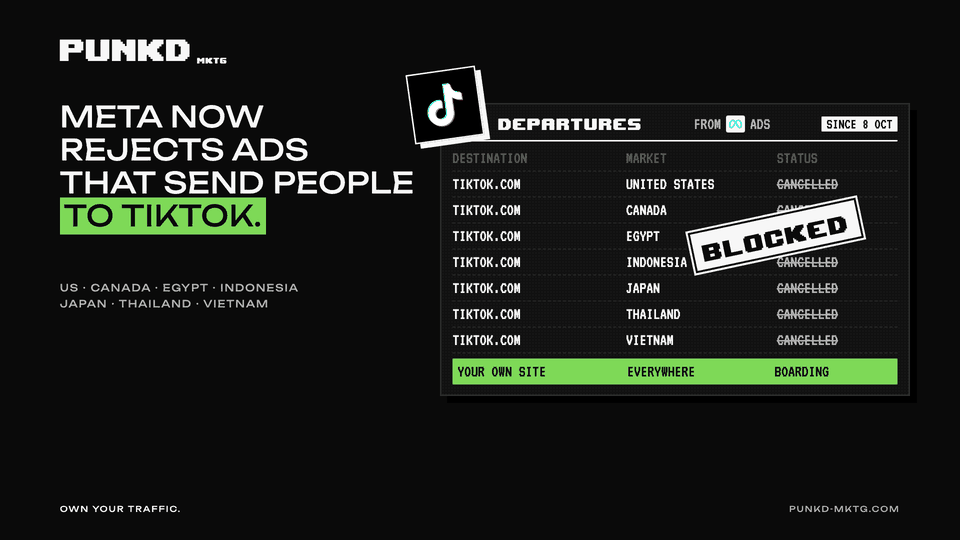
Meta now rejects ads that send people to TikTok. Own your traffic.
TL;DRAt a glance
- Since 8 October 2026, Meta has stopped running ads from TikTok's owner, ByteDance, on Facebook and Instagram.
- The ban also covers other advertisers' ads that link to TikTok or other ByteDance properties.
- It applies in the US, Canada, Egypt, Indonesia, Japan, Thailand and Vietnam.
- Creator campaigns and TikTok Shop funnels built on Instagram ads are the most exposed.
- Any route between two platforms lasts only as long as both platforms allow it.
- Send paid traffic to pages you own and collect contact details first.
- Meta has made it official: its ad system will not send people to its biggest rival. If your plan relies on Meta ads to grow a TikTok audience or a TikTok Shop, change it this week.
- Below: what was banned, why now, who is hit, a simple formula for your platform risk, and five fixes.
WHAT META BANNED, EXACTLY
Bloomberg broke the story on 8 October 2026. Adweek, WeRSM and ContentGrip followed with the details:
- Meta stopped accepting ads from ByteDance, the company that owns TikTok, across Facebook and Instagram.
- The rule also covers third-party advertisers whose paid campaigns send people to TikTok or other ByteDance properties.
- It applies in seven countries: the US, Canada, Egypt, Indonesia, Japan, Thailand and Vietnam.
- Enforcement began on Thursday, 8 October.
Meta spokesperson Chris Sgro described the decision as ordinary business practice. Meta's position, as reported: it does not have to provide promotional services to a company trying to pull people away from its apps.
What we don't know yet: every report is about paid ads. None of them mention organic posts or the links creators put in their own profiles. So don't panic and delete your bio links. Fix your ads.
WHY NOW: A FIGHT OVER AD MONEY
On 5 October, TikTok made its ad network available in the US for the first time. It lets advertisers run campaigns across about 400,000 third-party apps, straight from TikTok Ads Manager. The same week, TikTok pushed new tools that keep shopping inside its own app, like Buy Direct, which lets people buy a product from the feed without leaving TikTok.
Three days after that US launch, Meta closed its door. Read it as a traffic war. Each platform wants your ad budget, and each one wants your customers to stay inside its walls.
WHO GETS HIT
Creator campaigns. A creator's Instagram post boosted as an ad, ending with "full video on my TikTok", now points at a banned destination in those markets.
TikTok Shop sellers. Brands that use Instagram ads to send buyers to a TikTok Shop listing lose that route.
Cross-platform growth campaigns. Agencies that buy Instagram reach to grow a client's TikTok following have to rebuild.
According to ContentGrip, the destination alone can get an otherwise compliant ad rejected. Adweek's read: the ban shows why media buyers need to spread their spend across platforms.
HOW TO MEASURE YOUR PLATFORM RISK
Platform risk = revenue that depends on one platform's permission ÷ total revenue.
"Depends on permission" means the money only arrives if a platform keeps allowing something: an ad format, a link, a destination, an audience.
Say your store makes $100,000 a month. $30,000 of it comes from Instagram ads that send people to your TikTok Shop. Your platform risk on that route is 30%. Since 8 October, in seven countries, that 30% is exposed.
Now say those same ads sent people to a product page on your own site instead, with an email signup. You still depend on Meta for the ads, but the customer, the order and the email address are yours. Next month you can reach that buyer by email, by SMS or on any platform you like. The higher your platform risk, the less of your own business you control.
THE PUNKD TAKE
Everyone is framing this as Meta vs TikTok. It is really a reminder about who owns your customer. Platforms are landlords. They will rent you attention, but they will never let you walk their tenants to a rival building for free.
If your growth plan is one platform's ads feeding another platform's shop, you don't have a funnel. You have a favour, and Meta just ended it. The brands that shrug this off are the ones that already send paid traffic to pages they own.
STEAL THIS
- This week, export every live Meta ad in the seven countries and check each destination URL. Anything that lands on TikTok has to change.
- Send paid traffic to pages you own, and collect an email or phone number before anything else.
- Make each platform's ads complete on that platform. If the story needs "watch the rest over there", rewrite the ad.
- If TikTok Shop is a big sales channel, fund it with TikTok's own ads, not Instagram's.
- List every route in your plan where one platform sends people to another, and work out the platform risk of each.
THE SHORT VERSION
- Since 8 October, Meta rejects ads that send people to TikTok in seven countries.
- Creator and TikTok Shop funnels built on Instagram ads are the first to break.
- Platform risk = revenue that depends on one platform's permission ÷ total revenue.
- Send paid traffic to pages you own, and own the customer data.
How much of your revenue would survive if one platform changed its rules tomorrow?
Most funnels have a weak spot nobody has priced. We find it before a platform does.
Book Free ConsultationSources