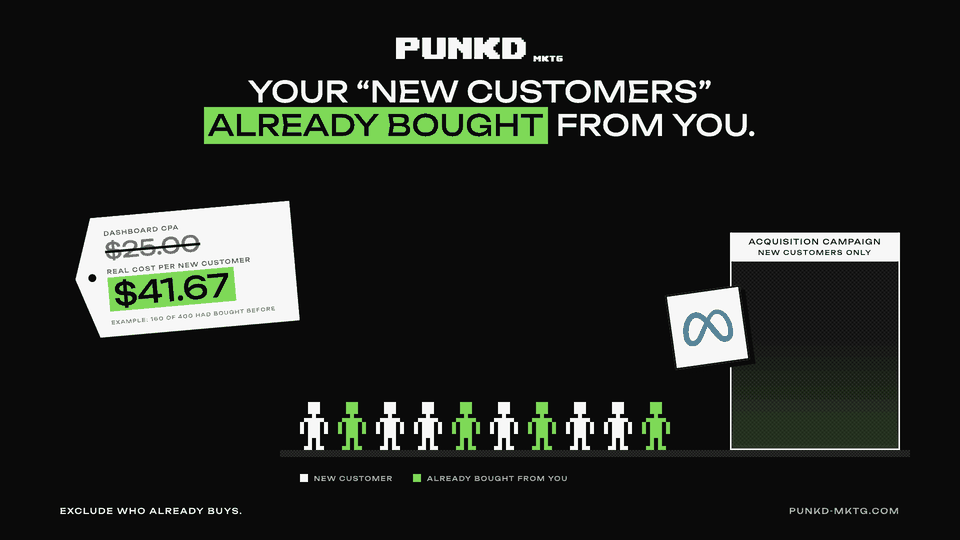
Your "new customer" ads are probably buying your old customers
TL;DRAt a glance
- Meta's Customer Lifecycle Strategy is now open to all advertisers.
- Label a campaign as acquisition and Meta recommends excluding people who already bought from you.
- Meta is testing a way to exclude a whole group of existing customers with one Audience Label.
- Meta claims 5% more conversions at the same cost for advertisers who follow its AI recommendations, with no method published.
- The number to watch: true new-customer CPA, ad spend divided by first-time buyers only.
- Turn the exclusions on, then compare before and after with your own order data.
Existing customers are the cheapest "conversions" in any ad account. When they slip into your acquisition campaigns, those campaigns look better than they are. Meta just gave every advertiser a switch for it.
Below: what Meta launched, the maths that shows what you were really paying, and how to set it up this week.
WHAT META LAUNCHED
At Advertising Week New York on 6 October, Meta announced: "Customer Lifecycle Strategy is now available to all advertisers." When you label a campaign as acquisition, it recommends excluding existing customers, so you no longer have to build those exclusions from scratch.
Meta is also testing "excluding an entire group of existing customers with a single Audience Label". An Audience Label is a tag for a group of people, like everyone who bought in the last year, that you can then include or exclude in one click.
ACQUISITION VS RETENTION, IN ONE LINE EACH
- Acquisition: ads meant to win people who have never bought from you.
- Retention: ads meant to bring back people who already did.
Both are useful jobs. The problem starts when one campaign quietly does both and gets judged as if it only did the first.
WHY OLD CUSTOMERS MAKE BAD CAMPAIGNS LOOK GOOD
Ad platforms optimise for whatever converts. People who already know and trust you convert fastest. So an acquisition campaign with no exclusions drifts toward your existing customers, books their purchases, and reports a beautiful cost per sale. Many of those people would have bought anyway, from an email, a search for your name, or habit.
THE MATHS: TRUE NEW-CUSTOMER CPA
CPA (cost per acquisition) is what you pay for each sale.
True new-customer CPA = ad spend ÷ first-time buyers only.
- Say a prospecting campaign spends $10,000 in a month and Meta reports 400 purchases.
- Platform CPA: $10,000 ÷ 400 = $25.
- Your own order data shows 160 of those 400 buyers had bought from you before.
- First-time buyers: 240.
- True new-customer CPA: $10,000 ÷ 240 = $41.67.
Same campaign, 67% more expensive than the dashboard said. And if your break-even cost for a new customer is $35, a "great" $25 campaign is losing money on every new buyer.
READ META'S 5% CLAIM CAREFULLY
Meta says advertisers who adopt its AI business assistant's recommendations "are typically seeing 5% more conversions at the same cost per conversion than those who don't." Meta has not published how it measured that. It is the seller grading its own product. Use it as a reason to test, not as a result to put in your forecast.
HOW TO SET IT UP
- Give Meta your customer data: connect your CRM or upload a customer list, so it knows who already bought.
- Label each campaign by job: acquisition or retention.
- In acquisition campaigns, accept the recommendation to exclude existing customers.
- Keep a separate retention campaign with its own budget, on purpose.
- Every month, match ad-attributed orders to your own order data and split first-time buyers from repeat buyers.
WHAT ELSE META ANNOUNCED
Meta says "more than 60% of the time people spend on Facebook and Instagram is with video." Generating video from existing static assets is now generally available, and AI audience discovery is coming to Detailed Targeting "by the end of the year."
THE PUNKD TAKE
Retention ads are fine. Paying acquisition prices for retention is not. We have managed $3.5M+ in ad spend on Meta and Google since 2023, and we typically find 18-30% of ad spend doing nothing at all. Paying again for buyers you already had is one of the usual suspects. Split the jobs, judge each on its own number, then scale what earns.
STEAL THIS
- Connect your customer list or CRM to Meta this week.
- Label every campaign as acquisition or retention. No mixed jobs.
- Turn on existing-customer exclusions in every acquisition campaign.
- Pull 30 days of orders and calculate true new-customer CPA.
- Compare the 30 days before and after the exclusions, and move budget to what wins.
THE SHORT VERSION
- Acquisition campaigns without exclusions drift toward people who already buy.
- True new-customer CPA = ad spend ÷ first-time buyers only.
- Meta's new setting makes the exclusion one click, for every advertiser.
- Treat Meta's 5% claim as a reason to test, not a result.
How many of last month's "new customers" had bought from you before?
We find the spend that is doing nothing and move it to what earns.
Book Free Consultation