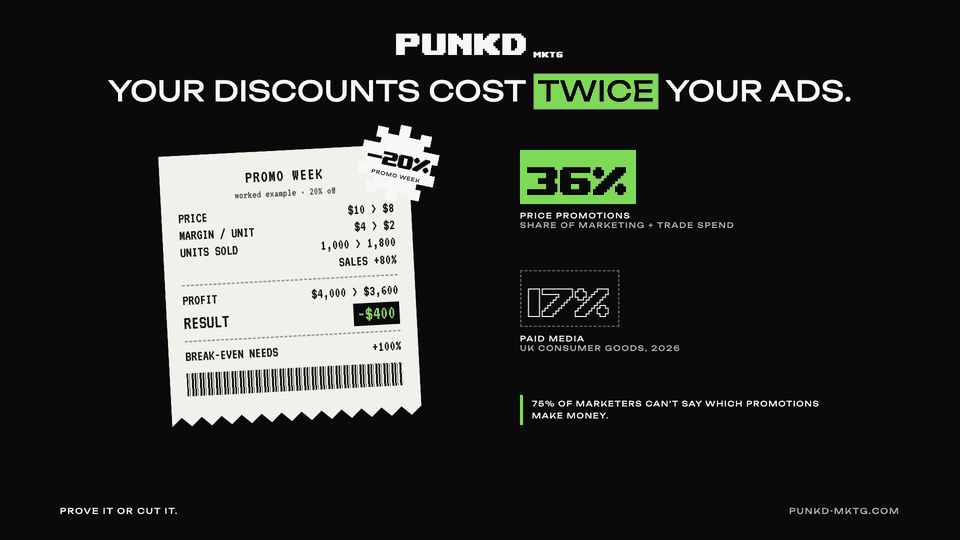
Your biggest marketing budget is your discounts. Do you know if they make money?
TL;DRAt a glance
- Price promotions take 36% of marketing and trade spend at UK consumer goods brands. Paid media takes 17%.
- 75% of marketers running promotions can't say what share of them made money.
- 80% agree many promotional buyers would have bought anyway.
- 68% would run fewer promotions if they could keep retailer support.
- A discount has to lift sales by more than most people think just to break even.
- The fix: test every promotion, cut the losers, reinvest in the brand.
Discounts have quietly become the biggest line in many marketing budgets. Bigger than ads. And most of the people spending that money can't tell you whether it pays.
Below: the new research, why a sales spike can still lose money, the formula to check any promotion, and a plan to fix it.
THE RESEARCH
Les Binet, co-author of The Long and Short of It, and Dom Boyd, Kantar's chief strategy officer, surveyed 250 marketing and insight leaders at UK consumer goods businesses. Censuswide ran the fieldwork. They presented the results at the IPA Effectiveness Conference on 7 October.
The headline numbers:
- Promotions: 36% of marketing and trade spend.
- Paid media: 17%.
- 75% of those involved in promotions could not estimate what share of their promotions made money over the past 12 months.
- 80% agree many promotional buyers would have bought anyway.
- 68% would prefer to run fewer promotions, if they could do it without losing retailer support, distribution or competitive position.
- 75% believe repeated promotions make shoppers more price sensitive.
Binet did not hold back: "Price promotions are like class A drugs: expensive, dangerous and addictive." Boyd: "Many are measuring promotions on gut feel or partial analysis, not really knowing what the impact on profit is."
WHY BRANDS KEEP DOING IT
The study lists the reasons: customers and the business expect them, brands want to defend market share, and retailers push for them. None of those is "we checked and it makes money".
WHY A SALES SPIKE CAN LOSE MONEY
Two things hide inside every promotion.
First, baseline sales: the people who would have bought at full price anyway. A discount hands them money for nothing. That is what the 80% are admitting.
Second, the hangover. Some shoppers stock up during the deal, then buy less after it. And if they learn the price drops every few weeks, they wait. That is the price sensitivity three in four marketers already believe in.
Incremental sales (the extra sales that only happened because of the deal) are the only ones that count. A dashboard showing total promo-week sales hides both problems.
THE MATHS: BREAK-EVEN UPLIFT
Break-even uplift = margin ÷ (margin - discount) - 1
Margin here is profit per unit at full price. Discount is the money off per unit.
Say a product sells for $10 and costs $6 to make and ship. You sell 1,000 a week. Margin: $4 a unit, so $4,000 profit a week.
- Run 20% off. Price: $8. Margin: $2.
- Break-even uplift = $4 ÷ ($4 - $2) - 1 = 100%.
You need to double weekly sales just to make the same profit. Sell 1,800 units, an 80% jump that looks great in a report, and you make 1,800 × $2 = $3,600. That is $400 less than doing nothing.
Now look at a deeper discount. At 30% off, margin drops to $1, and break-even uplift becomes $4 ÷ $1 - 1 = 300%. You need four times your normal sales.
HOW TO TEST A PROMOTION PROPERLY
- Set the baseline: average weekly sales at full price over the weeks before.
- Measure the real uplift: promo-week sales minus baseline.
- Measure the hangover: compare the weeks after with the baseline.
- Where you can, run the deal in some stores or regions and not others, and compare.
- Check profit, not volume.
THE BINET AND BOYD FIX
They do not say ban promotions. Their programme: train marketers, learn from the research, use econometrics (statistical models of what drives sales) to judge promotions, pricing and ads in one financial model, measure short and long-term effects, measure pricing power, then cut loss-making promotions and reinvest in the brand.
Binet's version: "The opportunity is to identify which promotions lose money, cut them out, and reinvest the money in brand advertising."
THE PUNKD TAKE
Discounts feel like performance because the sales line jumps the same week. Often it is the same customers buying the same stuff for less. We are not telling anyone to stop promoting. We are telling you to prove which promotions earn, kill the ones that don't, and move that money into building demand. The money is already in your budget. It is just hiding in the discount line.
STEAL THIS
- List every promotion from the last 12 months with its discount and its margin.
- Calculate the break-even uplift for each one.
- Compare it with the real uplift against a normal week.
- Track full-price sales for four weeks after each promotion ends.
- Cut the losers and move that budget into brand advertising.
THE SHORT VERSION
- Promotions now take more of the budget than paid media.
- Most marketers can't say which ones make money.
- A 20% discount on a 40% margin needs double the sales to break even.
- Test, cut the losers, and reinvest in the brand.
Which of your promotions would survive the break-even test?
We find the money doing nothing and move it to what earns.
Book Free ConsultationSources