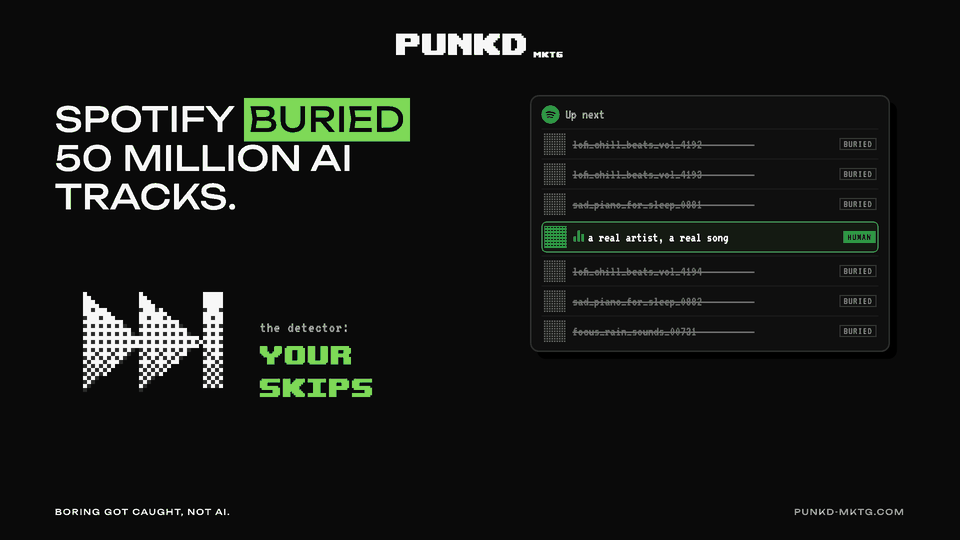
Spotify buried 50 million AI tracks. Listeners' skips gave them away.
TL;DRAt a glance
- Spotify pulled more than 50 million AI slop and spam tracks out of recommendations this year.
- It removed more than 75 million spammy tracks from the platform altogether.
- The pattern came from listeners: the tracks people skipped and ignored were consistently slop or spam.
- YouTube said on 1 October it will cut reach for Shorts channels that mostly repost other people's clips.
- Platforms now treat your audience's boredom as a quality score.
- Post less, track skips and hold rate, and add something only you have.
Spotify did not find the AI junk with a magic detector. It found it by watching what people skipped. That should scare every brand pumping out content by the hundred.
Below: what Spotify announced, how it catches slop, why YouTube is doing the same, the simple maths of skips, and what to change in your content plan.
WHAT SPOTIFY ANNOUNCED
On 20 October Spotify published "One Year In: Putting Human Artistry First on Spotify". The numbers:
- More than 50 million slop and spam tracks taken out of recommendations this year.
- More than 75 million spammy tracks removed from the platform altogether for serious or repeated violations.
"Slop" is the internet's word for cheap, mass-produced AI content that nobody asked for. Spotify's editors no longer program it, and the company says listener complaints about it showing up in recommendations have dropped "markedly". The Verge adds that Spotify gives artists with an AI identity an "AI Persona" badge and does not recommend their music.
THE SIGNAL THAT GAVE IT AWAY
The most useful line in the post is about how Spotify spotted the problem. Earlier this year it looked closely at the tracks listeners were skipping, ignoring or saying they did not want to hear. In Spotify's words: "these tracks were consistently ones identified as slop or spam."
So the first detector was the audience. People did not need a label to know something was cheap. They just moved on.
Spotify now combines several signals, because no single one works alone: listener engagement and feedback, upload patterns, metadata, and information from outside AI detection tools. It says plainly that AI detection has limits and will get harder. Engagement does not have that problem.
It also lists the tactics it hunts: mass uploads, duplicates, SEO manipulation, spammy playlist networks and artificially short tracks.
IT IS NOT JUST MUSIC
On 1 October YouTube announced it will push original Shorts and cut the reach of channels that mainly re-upload other creators' clips without real changes. YouTube's Rene Ritchie said voice-over narration, small technical edits and template-based bulk changes do not make a reused clip original. Commentary, analysis, real editing and storytelling do. The change is about reach, not money, and a channel that switches to original work gets re-evaluated.
Two of the biggest feeds on earth said the same thing in the same month: volume without value now costs you distribution.
THE MATHS OF SKIPS
- Skip rate = skips ÷ views.
- Hold rate = people still watching after the first few seconds ÷ views.
Here is a made-up example. A brand posts 30 AI-made Reels a month. Each gets shown to 1,000 people, and 700 swipe away in the first seconds. That is a 70% skip rate across 30,000 views.
The brand thinks it bought 30 chances at reach. The feed sees 21,000 people saying "not this". Every weak post makes the next one harder to distribute.
Now say the same brand posts 8 pieces, each with a real opinion or real footage, and only 40% swipe away. Fewer posts, but each one teaches the algorithm that your account is worth showing.
WHAT YOUR CONTENT PLAN LOOKS LIKE TO A PLATFORM
Take Spotify's list of spam tactics and swap "tracks" for "posts":
- Mass uploads: posting in bulk because a tool makes it cheap.
- Duplicates: the same idea in five near-identical formats.
- SEO manipulation: keyword-stuffed captions nobody reads.
- Spammy playlist networks: engagement pods and comment swaps.
- Artificially short tracks: thin posts made only to keep the calendar full.
If that sounds like your content calendar, the platforms already know.
THE PUNKD TAKE
AI did not get caught. Boring did. The platforms simply started listening to the people scrolling past. Using AI is fine. We use it every day. Using it to flood the feed with things nobody wants is what gets punished, and the punishment is quiet: lower reach, no warning, no email. The fix is not a better tool. It is a better reason for someone to stay.
STEAL THIS
- Cut your posting volume by a third for a month and see if reach per post rises.
- Report skip rate and hold rate for every post, next to reach.
- Delete near-copies from your plan. One strong version beats five weak ones.
- Use AI for drafts and edits, then add something only you have: a real opinion, real footage, real numbers.
- If you repost clips, add commentary or analysis that changes what the viewer gets.
THE SHORT VERSION
- Spotify pulled 50 million+ AI slop tracks from recommendations, and skips exposed them.
- YouTube is cutting reach for channels that repost without adding anything.
- Your audience's boredom is now a ranking signal.
- Post less, measure skips, add something real.
How many of your posts this month would you have skipped?
Want a content plan built for reach, not volume? Start at.
Book Free ConsultationSources
- https://newsroom.spotify.com/2026-10-20/prioritizing-human-artistry/
- https://www.theverge.com/entertainment/1014284/spotify-ai-slop-spam-songs-removed
- https://www.searchenginejournal.com/youtube-original-shorts-reposted-clips-reach/591774/
- https://ppc.land/re-uploaded-shorts-lose-reach-as-youtube-favours-original-clips/