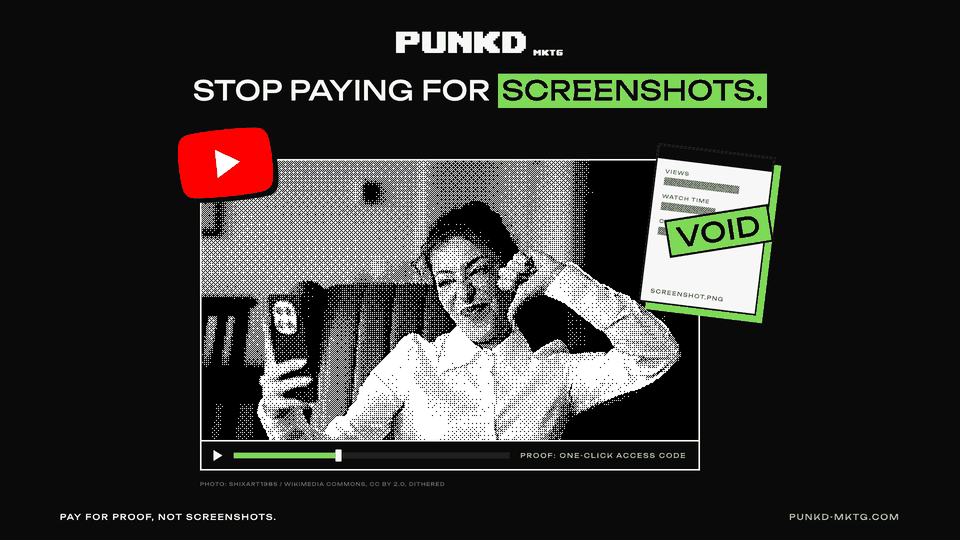
Stop paying YouTubers for screenshots. YouTube just made them worthless.
TL;DRAt a glance
- Paying on screenshots is over: a one-click code now shows brands a video's real numbers.
- The same access lets brands put paid media behind the videos that already work.
- YouTube says shopping tags get more than twice the clicks of links in the description.
- Over 1.3 million creators are in its affiliate program, which reaches 35 countries by year end.
- Brands can now offer creators exclusive commission rates or bonuses for featuring their products.
- Pay for proof: price creators on real views, boost the winners, pay the long tail per sale.
- Most brands pay YouTube creators on follower count, then judge the video from a screenshot the creator sends back. On 23 September, at Made on YouTube, YouTube made that screenshot worthless: brands can now see the real numbers in one click.
- Below: what launched, the maths for judging a creator deal, and a playbook you can use on your next brief.
THE ONE-CLICK CODE THAT KILLS THE SCREENSHOT
YouTube Creator Partnerships, YouTube's own system for brand deals with creators, is now available in 20 countries.
The key new piece, in YouTube's words: once a creator posts a brand partnership, they "can share brand partner access using a one-click code, making it easier than ever for your brand partners to view your video's performance and put paid media behind your content using creator partnerships boost."
Creators also get help from Ask Studio, YouTube's AI assistant, to write tailored replies to brand briefs and improve their media kit. Expect more pitches, and sharper ones.
YOUR "CHEAP" CREATOR MIGHT BE YOUR MOST EXPENSIVE
Until now, a brand usually learned how a sponsored video did from the creator: a screenshot or a PDF. You could not check it, and you could not compare creators on the same numbers. So deals got priced on follower counts, which tell you how many people once pressed a button, not how many watch today.
With real numbers, you can price a deal properly:
Cost per 1,000 views (CPM) = creator fee ÷ views × 1,000
Example (made up, to show the maths): Creator A charges $3,000 and the access code shows 150,000 views. That is $20 per 1,000 views. Creator B charges $1,500 and gets 30,000 views. That is $50. The "cheap" creator costs two and a half times more for every person who actually watched.
BOOST WHAT ALREADY WORKS
Creator partnerships boost lets the brand run paid media behind the creator's own video. That changes the order of work.
Old way: pick one creator, pay a big fee, hope. New way: test several creators with normal posts, read the real numbers through the access code, then put paid budget behind the one or two videos that already earned attention. You are scaling proof instead of a guess.
TAGS GET MORE THAN 2X THE CLICKS
YouTube's own finding: "YouTube Shopping tags drive more than twice as many clicks as adding links in the description."
Tags now also show a link localised for viewers in other countries, and creators still earn commission on those sales. So one video can sell across borders without a separate link for every market.
PAY THE LONG TAIL PER SALE
The affiliate program is big and growing. YouTube says "over 1.3 million" creators are in it, "driving a 13x growth in Gross Merchandise Volume (GMV) over the last two years." GMV is the total value of goods sold through the program. It is expanding to 35 countries by the end of the year, and Amazon product tagging is coming to India and Brazil "in the coming weeks."
New affiliate campaigns let retailers and brands "offer incentives, like exclusive commission rates or bonuses" when creators make content featuring specific products.
The maths is simple:
Affiliate cost per sale = product price × commission rate
Example (made up): a $60 product at a 15% commission costs you $9 per sale, and you only pay it when someone buys. A flat $1,500 fee buys the same money's worth only if the video drives about 167 sales. For smaller creators, affiliate is usually the fairer deal for both sides.
THE PUNKD TAKE
Follower count was always a vanity metric, and paying on it was guessing with real money. YouTube just removed the last excuse.
Brands that keep pricing creators on followers after this are choosing not to know. Creator marketing is not magic and it is not a lottery. It is media buying with a human face, and media gets bought on performance. Test small, read the real numbers, back what works, and scale the hell out of it.
STEAL THIS
- Make the one-click access code a condition of the final payment in every creator contract.
- Compare creators on cost per 1,000 real views, not followers.
- Test several creators with normal posts first, then boost only the videos that already work.
- Ask creators to use shopping tags, not just description links.
- For smaller creators, offer an affiliate campaign with an exclusive commission rate instead of a flat fee.
THE SHORT VERSION
- Creator deals on YouTube now come with real performance data. Use it.
- Price creators on real views, not followers.
- Boost the videos that already work.
- Tag products and pay the long tail per sale.
How much of your creator budget went on follower counts last quarter?
We help brands pay for proof, not screenshots.
Book Free Consultation