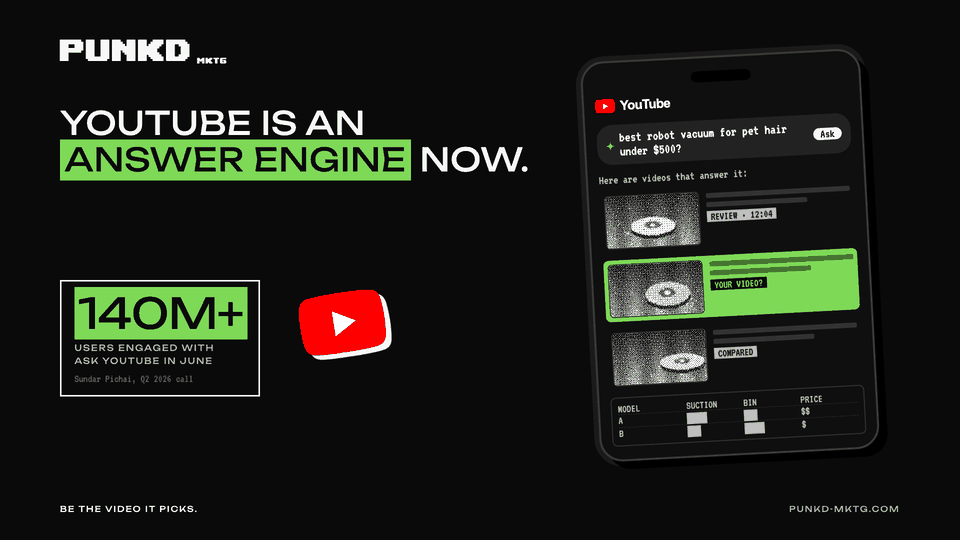
YouTube is an answer engine now. Your videos are the answers.
TL;DRAt a glance
- Ask YouTube, YouTube's AI search, is now open to every US user on web, mobile and TV.
- People ask full questions and get answers built from videos, with follow-ups.
- Over 140 million users engaged with Ask YouTube on the watch page in June.
- Product review searches may return comparison tables of review videos.
- Answers are ranked on relevance, engagement and quality, like normal search.
- If your videos don't answer buyer questions, someone else's video will.
- YouTube is no longer just where people watch. It is where they ask, and the answer comes back as a video. Brands that only post ads and launch films are not in those answers.
- Below: what Ask YouTube does, the numbers behind it, how products show up, and how to become the video it picks.
WHAT AEO MEANS ON YOUTUBE
AEO (answer engine optimisation) means making your content the one an AI tool picks when it answers a question. On Google, the answer is text and links. On YouTube, the answer is a set of videos, sometimes with a summary on top.
Most brands still think of YouTube as a TV channel: upload the ad, run pre-roll, check the views. That model ignores the biggest change on the platform this year.
WHAT ASK YOUTUBE IS
Ask YouTube is a conversational search tool, powered by Google's Gemini AI. YouTube describes it as a tool that "allows users to ask complex queries, refine with follow-up questions, and receive results in an interactive format." It also takes voice commands, so people can use it from the couch on a TV.
YouTube began testing it in 2023. This week the search version became available to all US users, after desktop and connected TV, with the mobile app as the latest addition. 9to5Google reports it is open to all users, not just Premium subscribers.
There is also a second version on the watch page: a button under selected videos that answers questions about the video you are watching. YouTube's help page lists that one in many countries and languages, for signed-in users aged 13 and older.
THE NUMBERS SAY IT IS ALREADY BIG
On Alphabet's Q2 2026 earnings call, Sundar Pichai said over 140 million users engaged with Ask YouTube on the watch page in June. That was before the search version reached every US user.
And the habit is spreading beyond YouTube. A Pew Research study found about half of US adults now use AI chatbots, up from a third in 2024. People are learning to ask instead of type keywords, and YouTube is catching that behaviour inside its own app.
HOW PRODUCTS SHOW UP
At its Made On YouTube event on 23 September, YouTube said product review searches in Ask YouTube may return organised video recommendations and "a comparison table that includes product attributes and categories based on your preferences," in the words of Johanna Voolich, its VP of Product Management for Viewer Products.
- Three more details matter for brands:
- The watch-page help page says eligible tagged products may appear in responses.
- YouTube is testing Ask YouTube inside select Shorts. Viewers tap a sparkle icon and ask about the Short on screen. The test is English only, for viewers 18 and older.
- As of September, YouTube's search help page said Ask YouTube conversations aren't used to show ads in this experimental phase. You can't buy your way into these answers yet.
WHAT DECIDES WHICH VIDEO GETS PICKED
YouTube's search help page says Ask YouTube responses prioritise "relevance, engagement, and quality," much like regular YouTube search. YouTube has not explained the details, and neither has anyone else.
So work with what is known. Relevance means your video clearly answers the question being asked. Engagement means people watch it and react to it. Quality is YouTube's judgement of the video and the channel. A brand video that never names the problem it solves loses on the first one before anything else counts.
A worked example. Say you sell a robot vacuum. A buyer asks: "best robot vacuum for pet hair under $500". Today the answer is probably built from creator reviews that compare suction, bin size and price. If none of those creators were briefed on your product, and your own channel has only a 30-second ad, you are not in the comparison. One honest, specific video titled with that exact question gives YouTube something to pick.
THE PUNKD TAKE
Brands still treat YouTube as a place to park their TV ad. That made sense when YouTube was a TV channel. Now it is a search engine that answers in videos, and most brand channels answer nothing.
The creators who explain your product better than you do are writing your AI reputation right now. Help them do it properly, or make the video yourself.
STEAL THIS
- Ask YouTube your top 10 buyer questions (from a US account, or ask a US colleague) and list every video it uses in the answers.
- Make one video per buying question. Title it as the question and answer it in the first 30 seconds.
- Say the product name, price and key specs out loud, then repeat them in chapters and the description.
- Tag your products in videos wherever YouTube lets you.
- Brief the creators who review your category on the attributes buyers compare, with real facts and samples.
THE SHORT VERSION
- Ask YouTube turns YouTube searches into answers built from videos.
- Over 140 million users engaged with it on the watch page in June alone.
- Product questions may return comparison tables of review videos.
- Make videos that answer buyer questions, or a creator's video answers for you.
If someone asked YouTube to compare you with your biggest rival, whose video would answer?
Most brands make YouTube ads. Very few make YouTube answers. We make both.
Book Free ConsultationSources
- https://www.socialmediatoday.com/news/youtube-rolls-out-ai-search-chatbot-to-all-us-users/832923/
- https://9to5google.com/2026/10/13/ask-youtube-rolls-out-on-mobile/
- https://www.searchenginejournal.com/youtube-test-ask-youtube-shorts-player/592723/
- https://www.searchenginejournal.com/youtube-shopping-ask-youtube-ai-search/590662/